
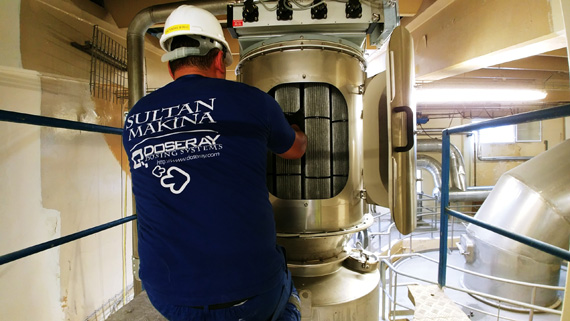
What Is a Silo and Hopper Filter, and How Is It Used?
All powdered raw materials subjected to mechanical handling (in short, bulk solids) inevitably generate dust once they enter the process because of their micronised structure. The dust collection equipment used to prevent this and separate the material from the air again is called a filter. Filters keep powdered bulk solids within an enclosed volume such as a silo or hopper, while the air is discharged through the filter outlet. The same equipment can also collect dust suspended in the atmosphere at a single point without compromising comfort in the working area; this application is known as a dust collection system.
Using packaged dust collection, pulse-jet filter and cyclone solutions selected according to your process, the particle size of the bulk solid being conveyed and whether the system runs under vacuum or pressure, filters keep the working environment within limits that do not harm human health.
For pulse-jet filters, we work with our European solution partners as well as domestic filter media manufacturers and specialist filter element producers, and build pulse-jet cleaning systems of our own design. Depending on the process, filter elements are produced as bags, cassettes or cartridges in 100% Teflon (DuPont), antistatic, moisture-resistant and FDA-approved versions. Our production programme also includes filter systems tailored to your plant, using special filter media resistant to heat, moisture and fire as the process requires.
Under Article 1 of the Regulation on the Control of Industrial Air Pollution, published in Official Gazette No. 27277 dated 3/7/2009, dust emissions in flue gas must not exceed 100 mg/Nm³. The filter media we use achieve dust emissions of <1 mg/Nm³. The filter medium is class M according to DIN EN 60335-2-69 and offers filtration efficiency of up to 99.9% for dust between 0.2 and 2 μm.
 Under the new ISO 16890 standard, these emissions are defined by the ISO ePM1 and ISO ePM2.5 classes.
ISO 16890 is an international standard developed for testing and classifying air filters used in general ventilation systems. Replacing the former EN 779 standard, this global standard assesses filters' particle retention performance with a more realistic, health-focused approach. Classification by particle size: filter efficiency is assessed across particulate matter (PM) size ranges between 0.3 µm and 10 µm, which are the most critical for human health. PM efficiency groups: according to their performance, filters are divided into four main groups: ISO ePM1, ISO ePM2.5, ISO ePM10 and ISO Coarse. Electrostatic conditioning: to simulate the weakening of the electrostatic charge on filters over time, tests are carried out with isopropanol (IPA) vapour to determine minimum efficiency values. Whereas EN 779 measured only particles of 0.4 µm, ISO 16890 assesses a broad range from 0.3 µm to 10 µm.
In addition, drum-type dust extraction systems used in open areas are practical, portable vacuum solutions that collect and filter the chips, dust and particles generated in industrial production directly into a container.
Cyclones and Pulse-Jet Filters
In all pneumatic systems, a cyclone is the conical unit that separates dust from air using centrifugal force. When an air–dust/granule mixture arriving at a given air flow enters the cyclone, it slows down as the cross-section increases and forms a vortex.
In other words, when the fast-moving air–dust mixture suddenly enters a larger volume, the powder or granular material falls under gravity and centrifugal force while the air exits to atmosphere. That, in short, is how cyclones work. Depending on the process, the cyclone inlet can be square, rectangular, round or tangential.
Dust Collection Performance of DOSERAY Filters
All filter elements are manufactured to operate at temperatures of up to 80–150 °C and retain particles of 1–5 microns; closely spaced pleats give them a high dust holding capacity. Depending on the process, they also undergo 1) surface singeing, 2) calendering, 3) Teflon impregnation, 4) PTFE coating and 5) special resin coating.
Bulk Tanker Loading Bellows Filters: Working Principle, Importance and Selection Criteria
Bulk tanker loading bellows are systems that allow bulk solids such as cement, lime, ash, plastic raw materials, food powders (flour, starch, etc.) and chemical powders to be loaded into tankers or bulk tankers without leakage. One of the most critical components in this operation is the loading bellows filter (integrated filter / dust collection filter).
1. What Is a Loading Bellows Filter and How Does It Work?
During bulk tanker filling, the flow of material generates considerable air pressure and heavy dust in the tank, so the air inside the tanker must be vented.
The filter cleans the vented air of the dust particles it carries:
• Air and dust separation: The pressurised, dust-laden air passes through filter cartridges or bags. Dust particles are retained on the outer surface of the filter while the cleaned air is released.
• Reverse-pulse cleaning (pulse-jet): The dust layer that builds up on the filter is shaken off by high-pressure air pulses at set intervals and falls back into the bulk tanker. This prevents product loss.
2. Why Is It Important? (Benefits)
• Environment and occupational health and safety (OHS): By preventing harmful fine dust from escaping into the atmosphere, it ensures compliance with environmental legislation and protects workers' health.
• Material savings: Valuable product that would escape with the air is returned to the bulk tanker by the filter, minimising product loss.
• Plant and vehicle cleanliness: It prevents dust build-up in the loading area, reducing cleaning costs and equipment wear.
• Explosion and fire risk control: It keeps under control the risk of combustible dusts (flour, starch, coal dust, etc.) causing an explosion in an enclosed space (ATEX).
3. Filter Types
Bellows with integrated (built-in) filters: The filter unit is integrated directly into the body of the loading bellows. This is a compact solution that needs no external ductwork or separate filter unit.
Bellows connected to an external central filter: The dust-laden air released during loading is drawn by a fan into the plant's central dust collection system.
Silo and Hopper Filter Systems
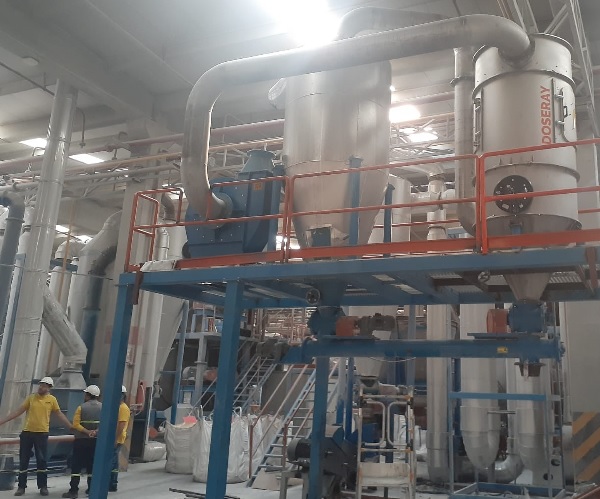
- Although the filter systems we manufacture may seem to be used only on silos, filters are used at many points in industrial plants, including silos, hoppers and on top of cyclones. The image above, showing a reactor-top cyclone feeding system, is the clearest example of this.
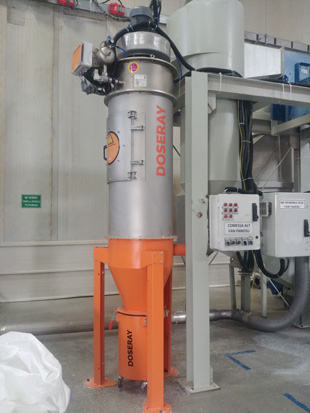
The hopper-type filter system shown alongside was built to ensure that dust released in the process does not harm workers in the area. Depending on the needs of the process, we can design custom solutions with diameters of 400-3,000 mm in various configurations, matched to the filter area (m²) and air flow.
- ATEX-Certified Ex-Proof Filters
-
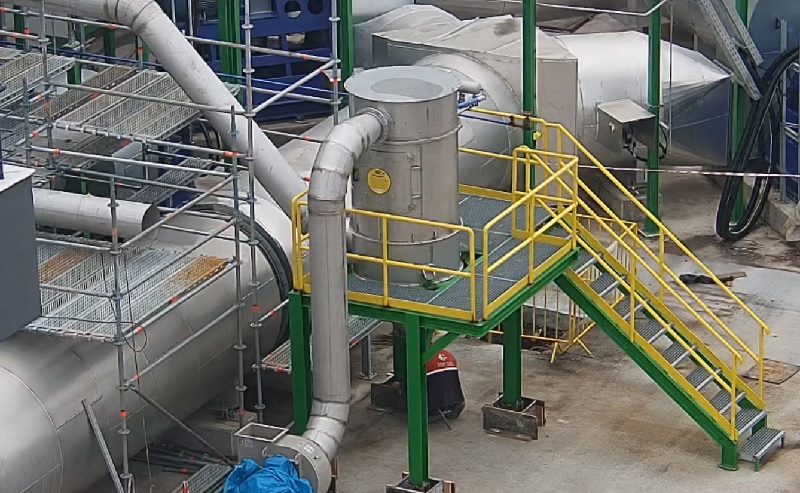
 Filter and Dust Collection Systems Catalogue