
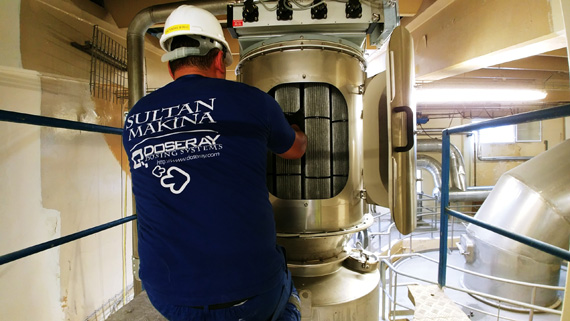
Blower Filters for Extruder Suction Systems
All powdered raw materials (bulk solids) processed pneumatically or mechanically inevitably generate dust once they enter the process. To prevent this and separate the material from the air again, dust collectors, in other words filters, must be used. If regrind or recycled material is used in plastic raw material vacuum loading systems, the separator of a standard loader may not be sufficient for separation. In this case an additional filter is needed, in particular to protect the blower. This removes any harmful dust from the system and protects the suction system.
Using packaged dust collection, pulse-jet filter and cyclone solutions selected according to your process, the particle size of the bulk solid being conveyed and whether the system runs under vacuum or pressure, filters keep the working environment within limits that do not harm human health. In processes that use recycled raw material in particular, a self-cleaning pulse-jet filter must always be installed upstream of the blower.
For pulse-jet filters, we work with our European solution partners as well as domestic filter media manufacturers and specialist filter element producers, and build pulse-jet cleaning systems of our own design. Depending on the process, filter elements can be 100% Teflon (DuPont), antistatic, water-repellent and FDA-approved, and are produced as bags, cassettes and cartridges. We also produce filter systems tailored to your plant, using special filter media resistant to heat, moisture and fire.
Under Article 1 of the Regulation on the Control of Industrial Air Pollution, published in Official Gazette No. 27277 dated 3/7/2009, dust emissions in flue gas must not exceed 100 mg/Nm³. The filter media we use achieve dust emissions of <1 mg/Nm³. The filter medium is class M according to DIN EN 60335-2-69 and offers filtration efficiency of up to 99.9% for dust between 0.2 and 2 µm.
Filter Solutions for Extruder Systems
In the drawing below, filters 3 and 22 are the solutions that protect the system upstream of the blower.

Cyclones and Pulse-Jet Filters
In all pneumatic systems, a cyclone is the conical unit that separates dust from air using centrifugal force. When an air–dust/granule mixture arriving at a given air flow enters the cyclone, it slows down as the cross-section increases and forms a vortex.
In other words, when the fast-moving air–dust mixture suddenly enters a larger volume, the powder or granular material falls under gravity and centrifugal force while the air exits to atmosphere. That, in short, is how cyclones work. Depending on the process, the cyclone inlet can be square, rectangular, round or tangential.
Our dust collection capabilities
All filter elements are manufactured to operate at temperatures of up to 150 °C and retain particles of 1–5 microns; thanks to their pleated design, they offer a large dust collection area in a small diameter. Depending on the process, they also undergo 1) surface singeing, 2) calendering, 3) Teflon impregnation, 4) PTFE coating and 5) special resin coating.
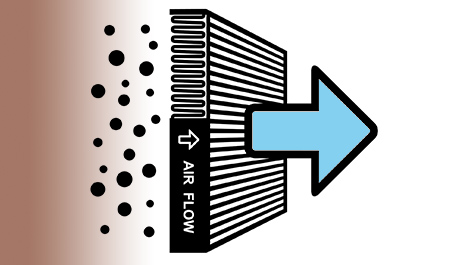
Silo Filter Systems
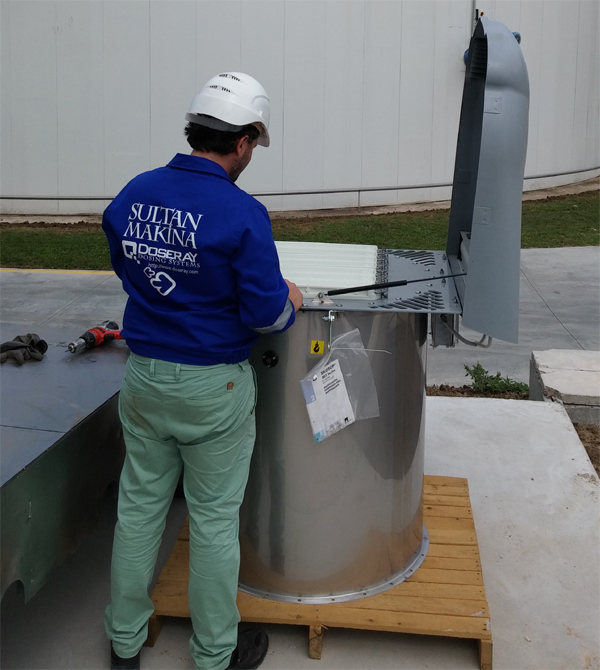
- The WAM Silotop, generally used on cement silos, is the most widespread filter in the world and has proven itself in the field over many years. It is also known as a cement silo filter. Compared with similar products, it stands out for the wide availability of spare parts and service and for its economy.
 Filter and Dust Collection Systems Catalogue