What Is a Pulse-Jet Filter and Where Is It Used?
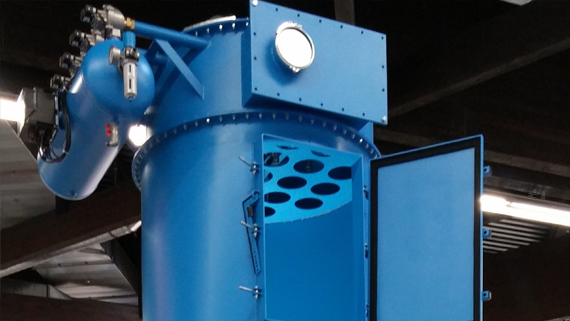
All powdered raw materials (bulk solids) handled pneumatically or mechanically inevitably generate dust once they enter the process, due to mechanical movement. The dust collectors used to prevent this and to separate the material from the air again are called filters. The name pulse-jet comes from the way the filters are cleaned with bursts of air; in other words, dust separation filters cleaned by air shocks (via diaphragm pulse valves) are called pulse-jet filters.
Depending on the nature of your process, the particle size of the conveyed material and whether it operates under vacuum or pressure, filters make the environment safe for human health through compact dust collectors, pulse-jet filters and cyclone solutions. The design and components of a pulse-jet filter must therefore be selected correctly at the manufacturing stage.
Choosing the wrong filter or filter media can cause the process to fail. For this reason, all the pulse-jet filters we manufacture in-house are built according to the character of the powder in the system to be filtered.
Cyclones and Pulse-Jet Filters
A filter is, in short, separation equipment used, above all in the food industry but also in the plastics, pharmaceutical and chemical industries, to separate airborne dust released during the transfer of all kinds of powder and granular materials or by mechanical movement within the process, and to collect it at one point. We design pulse-jet filters, which are used in many branches of industry, with filter areas of up to 1–200 m² to capture dust particles as small as 1–5 microns.
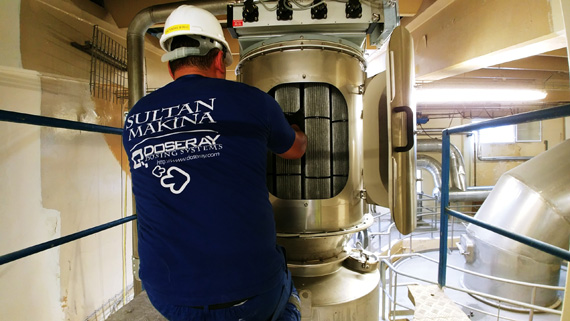
Depending on the process, wire-cage bag or cartridge filter media are used.
Dust Collection Capabilities of Pulse-Jet Filters
In pneumatic systems, a cyclone is a conical construction that separates air and dust by means of centrifugal force. When the air–powder/granule mixture arrives at a certain air flow rate and enters the cyclone, it slows down due to the larger cross-section and forms a vortex (swirling) motion.
In other words, when the fast-moving air–dust mixture suddenly enters a larger volume, the powder or granular material falls under gravity and centrifugal force, while the air exits to atmosphere. That, in short, is how cyclones work. Cyclone inlets may be square, rectangular, round or tangential, depending on the process.
Pulse-Jet Silo Filter Systems
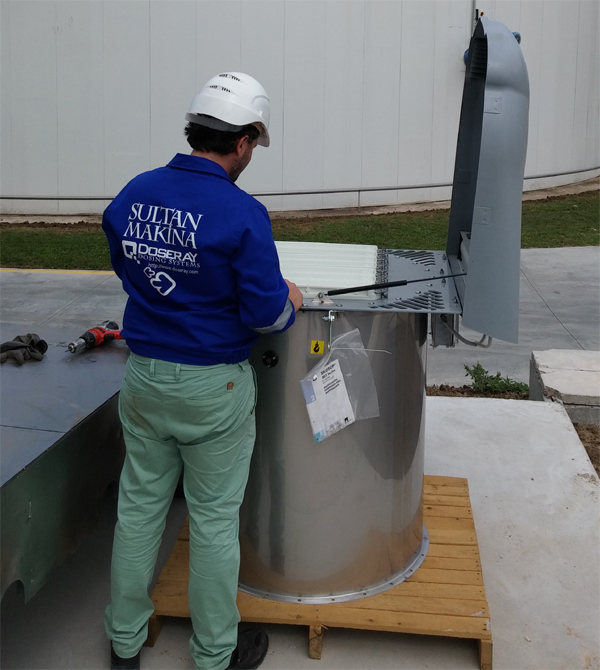
- The silo filters widely used in concrete batching plants are cartridge pulse-jet filters, as shown in the images. These filters take up little space and use common filter elements that allow easy access and maintenance.
According to the Regulation on the Control of Industrial Air Pollution published in Official Gazette No. 27277 of 7/2009, dust emissions in flue gas must not exceed 100 mg/Nm³. The filter media we use achieve dust emissions of <1 mg/Nm³. The filter media are class M according to DIN EN 60335-2-69 and offer filtration efficiency of up to 99.9% for dust between 0.2 and 2 μ.
 Filter and Dust Collection Systems Catalogue