Flour Cooling System
Fluidised-bed, closed-loop chilled-air flour cooling: a constant dough temperature and consistent product quality all year round for the bakery and biscuit industry.
For products to come out of industrial ovens with the same quality every day, the dough must reach a specific target temperature at the end of kneading (typically 24–26 °C for wheat doughs). In summer, after long tanker journeys and in silos exposed to the sun, flour temperature can rise to as much as 40 °C; at that point even iced water is not enough to bring the dough down to the target temperature.
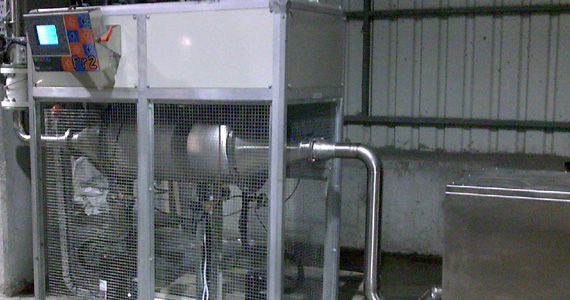
The DOSERAY Flour Cooling System cools the flour in a fluidised bed with chilled air circulating in a closed loop, inside an insulated, jacketed tank installed between the flour silos and the point of use. Heat is exchanged directly between the flour particles and the air; since there are no cold surfaces in the tank, no condensation forms.
Key features
- Low operating cost: Only electricity and cooling water are used; no CO₂ or liquid nitrogen has to be purchased. According to industry data, it is up to 8 times more economical than CO₂ cooling.
- Gentle, uniform cooling: Gradual cooling without sudden thermal shock; the gluten structure is preserved and every flour particle comes into contact with the chilled air.
- Precise temperature control: Recipe-based set point, closed-loop control with a temperature probe, and batch logging.
- Hygienic design: No moving parts or fittings inside the tank; easy to clean, with minimal dust emission.
- Easy integration: Compatible with new or existing lines and with vacuum or pressure pneumatic conveying systems.
Technical specifications and options
| Capacity | 1–2 t/h (per unit), batch operation |
|---|---|
| Temperature reduction | ΔT ≤ 20 K; flour outlet down to 5 °C with double heat exchanger |
| Cooling medium | Closed-loop chilled air, glycol-water coil |
| Material | Food-grade stainless steel; insulated, jacketed tank |
| Controls | PLC + touchscreen HMI, recipe and alarm management |
| Options | Double heat exchanger, ATEX design, automatic dusting-flour feed, SCADA connection |
How Does the Flour Cooling System Work?
Operating steps
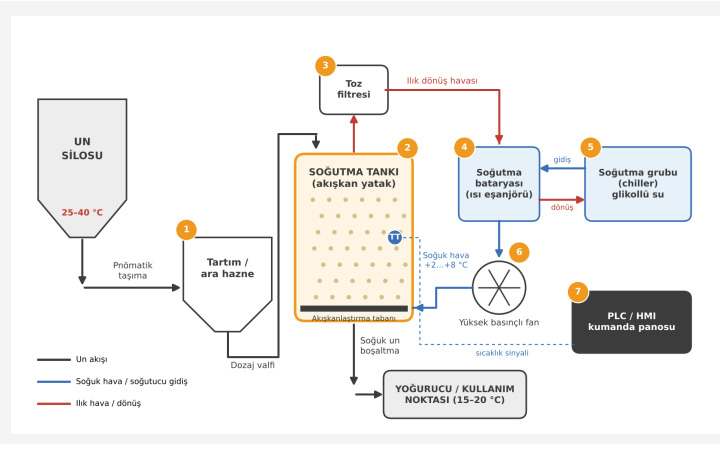
- Weighing and transfer: Flour conveyed pneumatically from the silo is weighed and transferred in batches to the cooling tank.
- Fluidisation: A fan blows air chilled in the coil in through the bottom of the tank; the flour forms a fluidised bed.
- Heat exchange: The chilled air contacts every flour particle; the warmed air passes through the filter and returns to the coil.
- Temperature control: A temperature probe controls the fan and coil until the set point is reached.
- Discharge: The cooled flour is sent directly to the kneader or to a buffer hopper.
Main components
- Weigh / intermediate hopper
- Cooling tank (fluidised bed)
- Dust filter
- Cooling coil
- Chiller unit
- High-pressure fan
- PLC / HMI control panel

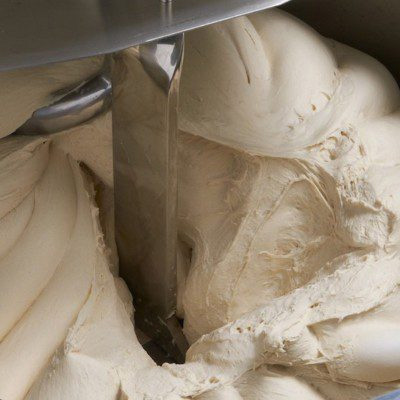
Why Cool Flour?
Dough temperature formula
The formula assumes a kneading temperature rise of 10 °C; high-speed kneaders heat the dough by 8–10 °C. When flour reaches 40 °C, however much you chill the water, it becomes very difficult to hit the target dough temperature. The real solution is therefore to cool the flour before it enters the kneader.
Consequences of warm flour
- Sticky dough that is hard to process
- Irregular proving, variable volume and size
- Breakage and waste during packing
- The cost and labour of adding ice, and dosing errors
Comparison of cooling methods
| Criterion | Ice / water | CO₂ | DOSERAY |
|---|---|---|---|
| Operating cost | Medium | High | Low |
| Cooling effect | Limited | High | High |
| Thermal shock | — | Yes | No |
| Temperature accuracy | Low | Good | Very good |
| Gas / asphyxiation risk | No | Yes | No |
| Regulatory approval | Not required | May be required | Not required |
| Automation | Manual | Automatic | Fully automatic |
Flour Cooling Technical Data
| Capacity (per unit) | 1–2 t/h |
|---|---|
| Operating mode | Batch |
| Temperature reduction | ≤ 20 K |
| Lowest flour outlet temperature | 5 °C (double heat exchanger) |
| Cooling medium | Closed-loop chilled air |
| Product-contact material | Food-grade stainless steel |
| Controls | PLC + HMI, recipe-based |
| Target dough temperature | 24–26 °C |
| Dimensions, power, cooling capacity | Project-specific |
Exact values are determined in the project calculation based on plant data. Subject to technical changes.
Options
- Double heat exchanger (flour down to 5 °C)
- ATEX design (special order)
- Automatic dusting-flour feed
- AISI 316L product-contact surfaces
- Cooled-flour buffer hopper
- SCADA / MES data connection
Information needed for a quote
Hourly consumption, batch size, summer and winter flour temperatures, target temperature, conveying system and ATEX zone information.
Applications
One system, many products.
Industrial Bread
Sandwich loaves, tin bread, sandwich rolls. Consistent proving time and volume.
Par-Baked / Frozen
Par-baked bread, baguettes, pizza bases. Low dough temperature is essential.
Laminated Doughs
Croissants, puff pastry. Low flour temperature so the fat does not melt (double heat exchanger).
Doughs for Frying
For doughnuts and similar products, dough temperature can be as low as 16 °C.
Biscuits · Crackers · Wafers
Consistency in texture, forming and cutting.
Pasta · Filo Pastry
Stable production in hot climates and in summer.

Frequently Asked Questions
Why is flour cooling necessary?
In industrial bakeries, the dough must reach a specific target temperature at the end of kneading, typically 24–26 °C for wheat doughs. In summer, after long tanker journeys and in silos exposed to the sun, flour temperature can rise to as much as 40 °C; at that point even iced water is not enough to bring the dough down to the target temperature.
How does the flour cooling system work?
Flour conveyed pneumatically from the silo is weighed and transferred in batches to the insulated, jacketed cooling tank. A fan blows air chilled in the coil in through the bottom of the tank, and the flour forms a fluidised bed. The chilled air contacts every flour particle, and the warmed air passes through the filter and returns to the coil. A temperature probe controls the fan and coil until the set point is reached, after which the cooled flour is sent to the kneader or a buffer hopper.
Does condensation occur during flour cooling?
No. Heat passes directly from the flour particle to the air rather than to a cold surface; since there are no cold surfaces in the tank, no condensation forms. Moisture in the air is condensed in the coil and drained off.
How does it compare with CO₂ or ice cooling?
The system uses only electricity and cooling water; no CO₂ or liquid nitrogen has to be purchased. According to industry data, it is up to 8 times more economical than CO₂ cooling. There is no thermal shock and no gas or asphyxiation risk, and it runs fully automatically.
How far can the flour be cooled?
The system provides a temperature reduction of up to 20 K. With the double heat exchanger option, the flour outlet temperature can be brought down to 5 °C.
 Flour Cooling System Catalogue