Static Mixer (Inline Mixer)
What Is a Static Mixer?
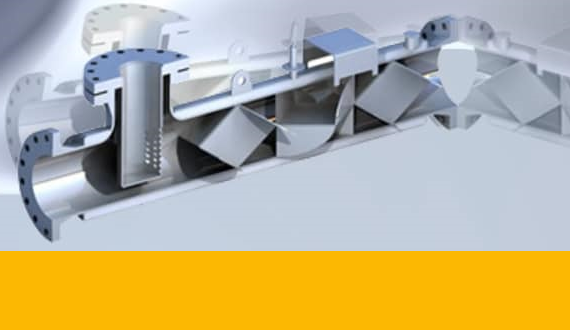
A static mixer is a mixer installed in the pipeline that has no moving parts. Fixed helical mixing elements inside the pipe continuously split the flow and change its direction, blending two or more fluids homogeneously. The energy needed for mixing comes from the flow itself, not from a motor.
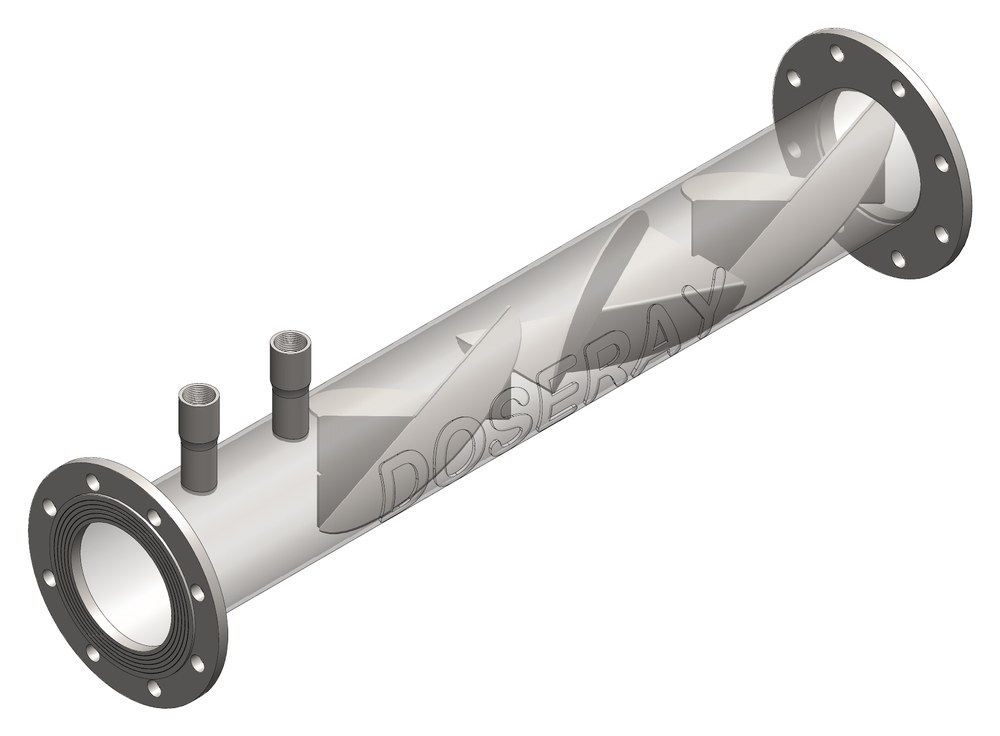
DOSERAY static mixers are flanged and mount directly into the existing pipeline. Two injection nozzles located upstream of the mixing elements introduce an additive, a second liquid or a gas into the main stream, which then blends with it as it passes through the elements. Dosing and mixing are thus carried out in a single inline component.
How Does a Static Mixer Work?
- Feed: The main fluid enters the mixer through the flanged inlet.
- Injection: An additive, a second liquid or a gas is introduced into the main stream through the nozzles just upstream of the mixing elements.
- Splitting and rotation: The first helical element splits the flow in two and rotates it in one direction.
- Repeat in the opposite direction: The next element has the opposite twist; the flow is split again and rotated the other way.
- Homogeneous outlet: Splitting, rotation and recombination are repeated in every element; as the flow travels down the pipe the mixture becomes homogeneous and continues into the line through the outlet flange.
A static mixer is ideal for continuously operating lines: the mixture forms at the same time and at the same rate as the flow. No separate mixing tank, motor or agitator shaft is needed.
Key Advantages of the Static Mixer
- No energy consumption: There is no motor or moving part; mixing energy is taken from the flow.
- Maintenance-free: With no rotating shaft, bearing or seal, the risk of wear and failure is very low.
- Continuous, homogeneous mixing: Provides repeatable mixing inside a closed line, simultaneously with the flow.
- Dosing and mixing in one: Integrated injection nozzles allow additives to be dosed directly at the mixer inlet.
- Small footprint: Works as part of the pipeline instead of a mixing tank.
- Easy installation: The flanged connection makes it easy to add to, or remove from, an existing line.
- Hygienic, closed system: Mixing takes place inside the line with no contact with the surroundings.
Technical Specifications
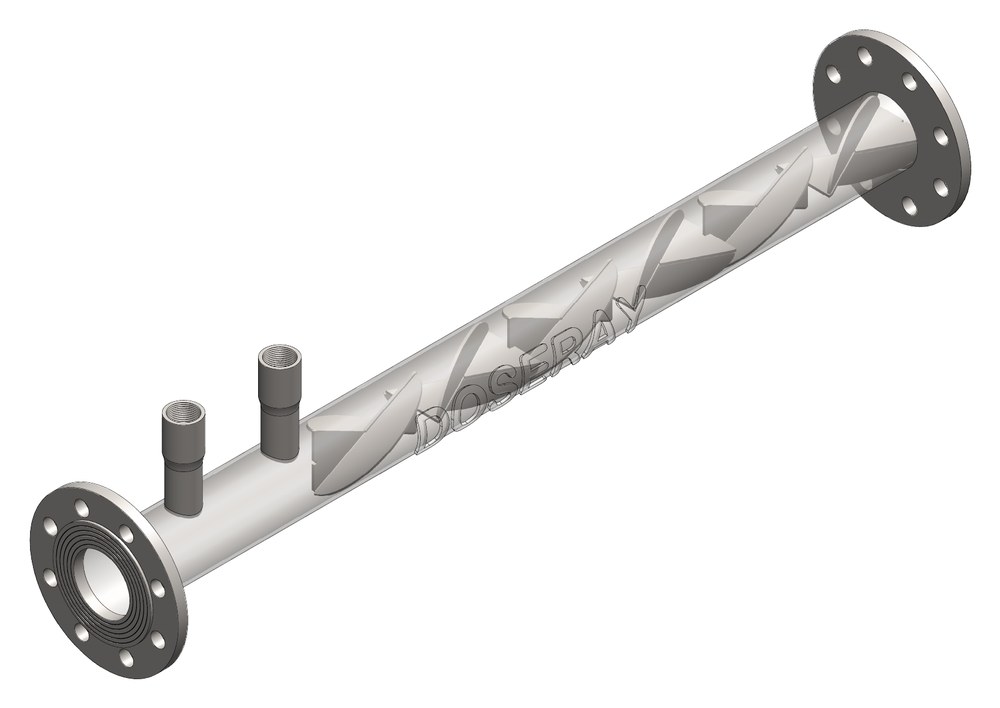
| Feature | DN50 | DN65 | DN80 | DN100 | DN125 |
|---|---|---|---|---|---|
| Pipe outside diameter | Ø60.3 mm | Ø76.1 mm | Ø88.9 mm | Ø114.3 mm | Ø139.7 mm |
| Overall length | 1000 mm | 1000 mm | 1000 mm | 1000 mm | 1000 mm |
| Flange outside diameter | Ø165 mm | Ø185 mm | Ø200 mm | Ø220 mm | Ø250 mm |
| Bolt circle diameter | 125 mm | 145 mm | 160 mm | 180 mm | 210 mm |
| Flange holes | 4 × Ø18 mm | 8 × Ø18 mm | 8 × Ø18 mm | 8 × Ø18 mm | 8 × Ø18 mm |
| Injection nozzle | 2 × Ø38 mm | 2 × Ø38 mm | 2 × Ø38 mm | 2 × Ø38 mm | 2 × Ø38 mm |
| Mixing element | Right- and left-hand helical elements in series | ||||
Flange dimensions comply with EN 1092-1 PN10/PN16. Other diameters, lengths, numbers of elements, materials and connection types (welded, threaded union, clamp) can be custom-built to suit your process.
Applications
Food and Beverage
Diluting syrup and glucose with water; inline blending of flavourings and additives.
Chemicals
Dosing chemical additives and blending them into the main stream; dilution and neutralisation.
Water and Wastewater
Homogeneous mixing after dosing of polymers, coagulants and disinfectants.
Gas and Liquid
Injecting and mixing gases into liquids, or liquids into gas streams.
Temperature Equalisation
Mixing streams at different temperatures to eliminate temperature differences.
Dosing Systems
An inline mixing solution together with liquid dosing and flowmeter dosing panels.
Frequently Asked Questions
What is a static mixer?
A static mixer is a mixer installed in the pipeline that has no moving parts. Fixed helical elements inside it continuously split the flow and change its direction, blending two or more fluids homogeneously. The energy needed for mixing comes from the flow itself.
How does a static mixer work?
Each helical element splits the flow in two and rotates it. Because the next element has the opposite twist, the flow is split again and rotated the other way. This splitting, rotation and recombination is repeated in every element, so the mixture becomes homogeneous as the flow travels down the pipe.
What are the injection nozzles for?
Located just upstream of the mixing elements, the nozzles introduce an additive, a second liquid or a gas into the main stream. The injected fluid blends homogeneously with the main stream as it passes through the elements.
What are the advantages of a static mixer?
With no moving parts and no motor, it consumes no energy, needs no maintenance and does not wear. It mixes continuously inside a closed line, takes up little space and connects easily to an existing pipeline by flanges.
What sizes of static mixer do you make?
Our standard models come in DN50, DN65, DN80, DN100 and DN125, with a length of 1000 mm. Other diameters, lengths, numbers of elements and connection types can be custom-built to suit your process.