
Liquid Dosing with a Dosing Panel and Flow Meter
What Is Liquid Dosing?
Liquid dosing means adding water, glucose syrup, invert sugar, liquid oil and other liquids to a mix in the quantity required by the recipe. Stable mixing ratios in your products go hand in hand with the quality of your work.
At first glance, using more raw material than required may seem to improve product quality, or your process tolerances may compensate for such errors. But whether or not they can be compensated, whatever you want to use in your mixes, and in whatever quantity, you should add exactly the target amount in one go. Achieving this and avoiding incorrect mixing ratios of any kind requires the right methods and the right tools: a correctly selected liquid meter (flow meter) and a dosing panel to control it.
How the Mini Dosing Panel Works
The mini dosing panel runs on today's industrial technology: a PLC, a touch panel and a rugged membrane switch display. The control unit, meter and valve are independent of one another.
- Quantity entry: The operator enters the quantity to be dosed on the panel or selects it from an automatic program.
- Valve opening: The panel opens the single- or double-acting dosing valve.
- Measurement: The panel counts the pulse signals from the in-line meter; the volumetric measuring technique adapts to constantly changing flow rates.
- Closing: When the target quantity is reached, the valve closes and the dose is logged.
- Safety: If a meter fault is detected at constant flow, the panel raises an alarm and, if required, shuts off the line automatically.
On constant-flow lines, time-based dosing is possible even without a meter, since the amount of liquid passing per unit time is constant. For tank weighing and in vibrating environments, the automatic tare function is used.
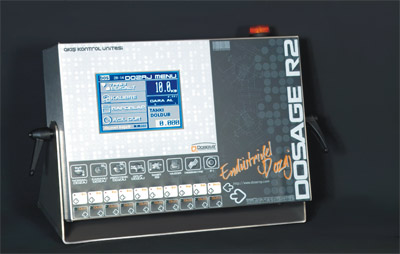
Technical specifications
| Accuracy | 0.5–1% (depending on meter type selected) |
|---|---|
| Dosing range | 0–9 L, 0–99 L, 0–999 L, 0–9999 L (selectable) |
| Compatible meters | All pulse-output meters, especially turbine and positive displacement types; inductive and capacitive sensors |
| High-speed counter input | 2 ml accuracy with 1000 pulses per litre on 1/2" pipe |
| Outputs | 4 relays for single- and double-acting valves; heating and cooling relay outputs |
| Communication | RS485, ready for all MODBUS applications |
| Control unit | Corrosion-resistant AISI 304 stainless steel |
| Panel dimensions | 400 × 100 × 280 mm (W × D × H) |
| Power supply | 220 V AC |
Key Features of the Mini Dosing Panel
- Easy calibration (QuickCab): User-friendly calibration for all liquids, whatever their viscosity.
- Adapts to variable flow: Accurate measurement at constantly changing flow rates thanks to the volumetric measuring technique.
- Automatic tare: For tank weighing and vibrating environments.
- Meter fault protection: Automatic alarm for meter faults at constant flow and, if required, automatic line shut-off.
- Constant-temperature storage: Heating and cooling relay outputs to keep storage tanks at a constant temperature. Important for liquids such as glucose and invert sugar, whose viscosity changes with temperature.
- Batch and periodic dosing: Periodic dosing by the minute, hour, day, month or year via an automatic program.
- Authorised access: Password-protected parameter entry and an administrator console for setting minimum/maximum values to prevent incorrect dosing.
- Reporting: Report screen showing daily, monthly and yearly totals and the last 15 doses.
- Software for every industry: Adaptable to food, chemical and other industrial processes.
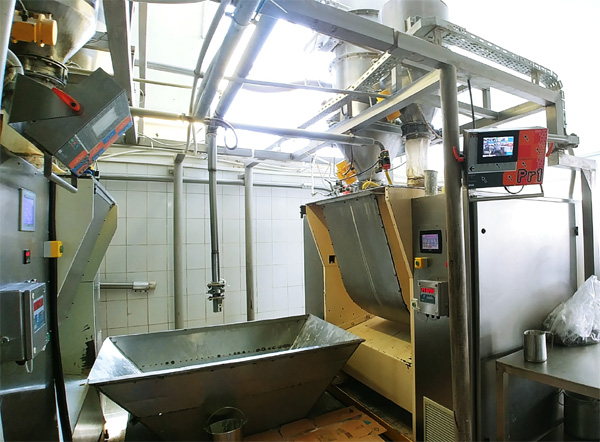
Liquid Meter (Flow Meter) Selection Criteria
1. Chemical composition of the liquid
The meter's wetted parts, i.e. all parts in contact with the liquid, must be compatible with the liquid to be measured. This compatibility is confirmed by previous use of the meter with the same liquid, chemical compatibility tables, the manufacturer's approval or the customer's approval.
2. Viscosity (flowability) of the liquid
The viscosity limits of meters vary with their operating principle, size, materials and brand. Temperature and viscosity are inversely related; for example, a viscous liquid from an outdoor tank that passes through a meter in summer may not pass through the same meter when the weather turns cold.
| Meter type | Suitable viscosity |
|---|---|
| Turbine type | Low |
| Disc type | Low and medium |
| Oval gear, sliding vane, ring piston, helix rotor | Low, medium and high |
3. Operating pressure
Minimum pressure: Every meter requires a minimum pressure above its pressure-loss value in order to operate. This is particularly important on lines where the liquid flows under its own weight (by gravity).
Maximum pressure: The upper limit set by the meter's design; exceeding it damages the meter. This value varies with the meter's operating principle, materials and intended use.
4. Operating and ambient temperature
Ambient temperature: The temperature of the environment in which the meter operates; particular care is needed in hot environments such as boiler rooms and in very hot regions.
Operating temperature: The temperature of the liquid passing through the meter. It depends on the materials used in the meter and the type of display; the minimum and maximum limits must be known.
5. Turndown range (minimum–maximum flow)
Every meter has a measuring range, which varies with the meter's operating principle and display type. The ratio between the lower and upper measuring limits can be 1:10 or 1:20 for turbine meters and up to 1:100 for oval gear meters. This ratio depends not only on the measuring system but also on the display type.
LIQUID DOSING SYSTEMS FOR BAKERIESFrequently Asked Questions
Which meter should be used for high-viscosity liquids?
Turbine meters are used for low-viscosity liquids and disc meters for low- and medium-viscosity liquids. For high-viscosity liquids such as glucose syrup, oval gear, sliding vane, ring piston or helix rotor meters should be chosen.
What is the accuracy of the liquid dosing panel?
Between 0.5% and 1%, depending on the meter type selected. With high-pulse meters, the high-speed counter input allows an accuracy of 2 ml to be achieved with 1000 pulses per litre on 1/2-inch pipe.
Why does temperature affect meter selection?
Temperature and viscosity are inversely related. A viscous liquid from an outdoor tank may pass through a meter easily in summer but not when the weather turns cold. The meter must therefore be selected for the liquid's coldest and hottest conditions.
Can dosing be done without a meter?
Yes. On constant-flow lines, the panel can dose by time, since the amount of liquid passing per unit time is constant.
Can the panel be connected to an automation system?
Yes. It is ready for all MODBUS applications via RS485. It also has a reporting screen showing daily, monthly and yearly totals and the last 15 doses.