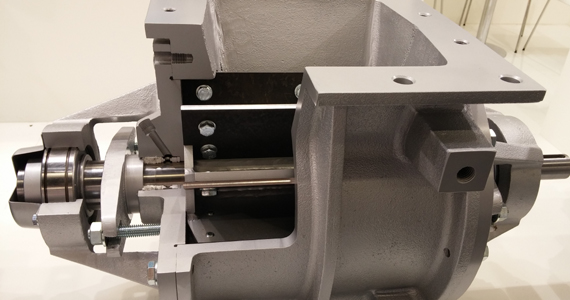

Airlocks for abrasive bulk solids (ash airlocks)
Airlocks and rotary valves used for conveying and separating fly ash produced as waste in thermal power plants, boilers and cement plants must have a different chemical composition from their standard counterparts; otherwise they can wear out quickly. The same applies to airlocks used in processes handling abrasive raw materials such as sand, ash, micronised calcite, dolomite, cement and quartz, particularly in the mining sector. These differences keep the process running reliably and without interruption.
In heavy-duty airlocks, the housing is made of Ni-Hard castings or Hardox plate, and the rotor is hardened or fitted with replaceable vane tips. The bearings are mounted away from the housing, and the seals are air-purged to keep dust away from the bearings. Rotor speed is also kept low to further reduce the rate of wear.
Chromium (Cr):
Chromium is the main alloying element in stainless steels. It provides corrosion and oxidation resistance, improves hardenability and increases wear resistance in high-carbon steels. Together with carbon, chromium forms the compound Cr23C6, which accumulates at the grain boundaries. In stainless steels, this compound lowers the chromium content at the grain boundaries below 12%, the threshold for stainlessness. It forms easily at high temperatures as carbon diffusion accelerates, and causes degradation around the weld seam in welded stainless steels.
Nickel (Ni):
Nickel increases impact toughness and the strength of annealed steels. It is the second most important alloying element in austenitic stainless steels after chromium; these steels contain 7–20% nickel. Nickel is an austenite stabiliser, so, as the name suggests, the lattice structure of austenitic stainless steels is FCC even at room temperature. The FCC lattice gives austenitic stainless steels excellent formability.
Molybdenum (Mo):
It prevents grain growth, improves hardenability and eliminates temper embrittlement. When some alloys are cooled slowly from the tempering temperature, carbides precipitate at the grain boundaries and cause brittleness; molybdenum
eliminates this adverse effect. It also increases the creep strength and wear resistance of steels. It is an important alloying element in alloy tool steels. In stainless steels it significantly improves corrosion resistance, in particular by preventing pitting corrosion. It is also used as a nitride- or carbonitride-forming element in some microalloyed steels.
Airlocks used in processes handling abrasive raw materials such as sand, ash, micronised calcite, dolomite, cement and quartz, particularly in the mining sector, must be built differently from their standard counterparts. These differences keep the process running reliably and without interruption.
These differences fall under three headings:
1- Sealing elements (gland packing, lip seals, etc.)
2- Wear-resistant housing design (lined or special alloy steel, Ni-Hard, carbide coatings, high-molybdenum castings)
3- Alloy steel rotors (Ni-Hard, Hardox, carbide coatings)
The picture below shows the result of choosing the wrong product in a pneumatic ash conveying process, and how important equipment selection is.

-

A1-A2-A3: Open vanes
B1-B2-B3: Radiused/oval vanes
C1-C2-C3: Adjustable and replaceable vanes
D1: Rotary valve with closed or adjustable rotor (dosing)
Rotary Valve – Airlock
Heavy-duty models for ash, sand and mineral powders
Blow-Through Rotary Valve
Blow-through rotary valves for pneumatic conveying of abrasive products are built from the same heavy-duty materials.
Wear-Resistant
Products


With abrasive products, monitoring wear is as important as extending airlock life. By measuring the rotor-to-housing clearance at regular intervals, you can see in advance when air leakage starts to increase, so vane tip replacement can be scheduled into maintenance before it turns into an unplanned shutdown.
With replaceable vane tips and spare seal kits kept in stock, maintenance of a heavy-duty airlock can be completed quickly without removing the housing from the line.
READ MORE Rotary Valve Catalogue