
Applications of offset-type airlocks
An airlock is a mechanical device with a vaned rotor, generally used in pneumatic conveying systems (pressure and vacuum) to separate powdered or granular product from the air. It is widely used under filters and cyclones in particular. While its diameter and speed determine capacity, vane clearances are the most important factor in its efficiency. An airlock can also be used as a feeder for dosing and as a metered discharger under silos. All this applies to general-purpose airlocks. If you will use an airlock for granular raw materials, it needs some fundamental differences from its standard counterparts. These are few in number but critical design changes, such as speed and inlet type. The rotor type for granule processes must also differ from standard models.
With plastic granules such as PE, PP and PET and with pelletised feed, detergent or food products, the biggest problem with a standard airlock is that the vane tip shears or crushes the particles as it reaches the housing inlet. This causes both product loss and rotor jamming with excessive current draw.
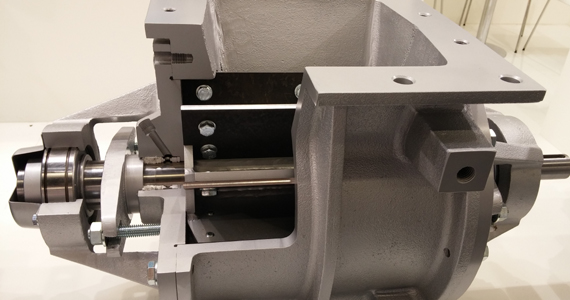
In an offset-type airlock, the product inlet is offset relative to the rotor axis. The vane reaches the housing inlet before the pockets are completely full, and the particles slide into the pocket without being trapped. If necessary, a flexible deflector at the inlet further prevents granules from getting between the vane tip and the housing.


-

A1-A2-A3: Open vanes
B1-B2-B3: Radiused/oval vanes
C1-C2-C3: Adjustable and replaceable vanes
D1: Rotary valve with closed or adjustable rotor (dosing)
Granule-type airlock (rotary valve)
Offset-inlet models for fragile granules and pellets
Blow-Through Rotary Valve
The offset inlet can be combined with blow-through rotary valves in pneumatic lines conveying granules.
Wear-Resistant
Products


For abrasive granules such as glass-fibre-reinforced plastics, the offset inlet is combined with a hardened housing and replaceable vane tips.
READ MORE Rotary Valve Catalogue