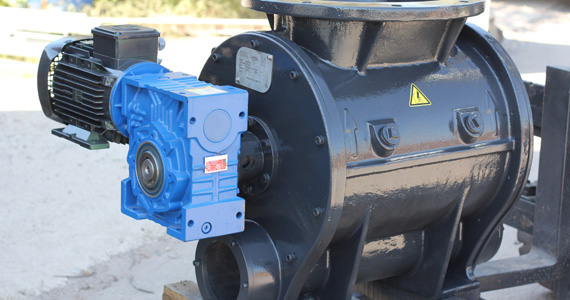
Rotary Valve Manufacturing: From Design to Testing
DOSERAY rotary valves are manufactured in our workshop in Çiftlikköy, Yalova. Each rotary valve is sized for the product and process it will handle; it is built to requirements, not taken off the shelf like a standard item.
Manufacturing Stages
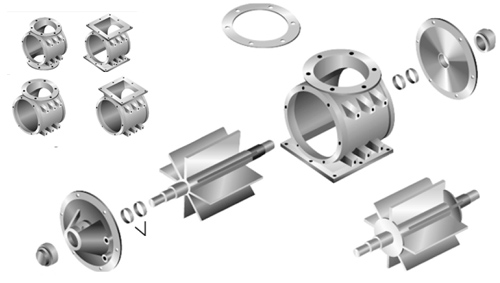
The housing and end covers are made of steel or stainless steel, and the rotor vanes are welded to the shaft. The housing bore and rotor outer diameter are machined to achieve the required tolerance. Bearings, seals and drive components are adjusted during assembly.
Testing and Delivery
Before delivery, each assembled rotary valve is checked to ensure that the rotor turns without rubbing the housing, the motor current is normal and the seals do not leak. For special applications such as rotary valves for granules and ash, the rotor and housing materials are selected to suit the product. For a quotation, write to info@doseray.com.
Rotary Valve Applications
A rotary valve is a vaned mechanical device generally used in pneumatic transfer systems (pressure and vacuum) to separate powder or granular product from air. It is widely used beneath filters and cyclones in particular. While the diameter and rotational speed determine the capacity of the unit, the vane tolerances are the most important factor determining its efficiency. A rotary valve can also be used as a dosing feeder and as a proportional discharger beneath silos.
As the name suggests, an airlock is something that traps or locks air; here, "trapping" means preventing air from passing through.
In vacuum or pressure systems, air and solid material in powder or granular form must either be separated from each other or mixed together for pneumatic conveying. Processes designed in this way are the main applications of the rotary valve.
In short, rotary valves are equipment used in pressure and vacuum systems to separate product from air or to mix it with air. They are generally used beneath cyclones and filters, or as intermediate equipment in various processes as a dosing rotor.
Rotary Valve – Airlock Types
A rotary valve may look like standard equipment at first glance, but it varies according to the process conditions and the characteristics of the raw material passing through it.
These characteristics mainly include capacity, temperature, abrasiveness, bulk density, particle size, operating pressure and chemical properties. They are the most important factors determining the type and design of the rotary valve.
Rotary feeders are manufactured in ST37 carbon steel, AISI 304 and AISI 316 stainless steel, Hardox and Ni-Hard. Bearing types and sealing elements (packing, mechanical seals, lip seals etc.) of the rotary valve also vary with the process. Rotors can be supplied with blade tips, rounded pockets, adjustable vanes, scrapers or polyamide tips, among other options.
Process-Specific Rotary Valves
-

- A1-A2-A3: Open vanes
B1-B2-B3: Radiused (oval) vanes
C1-C2-C3: Adjustable and replaceable vanes
D1: Rotary valve with closed or adjustable rotor (dosing)
Rotary Valve Dimensions
Type that takes product in at the top and discharges it at the bottom (also known as an airlock or rotary feeder).
Rotary Feeder – Blow-Through Rotary Valve
This type takes granular or powdered raw material in at the top of the unit and discharges it at the bottom by gravity and mechanical motion (also referred to as an airlock or rotary feeder; the only difference is that, because it is used in pneumatic lines, it has pipe inlet/outlet connections or an eductor).
Why a DOSERAY Rotary Valve?
Although the design and manufacture of a rotary valve look simple from the outside, they require know-how and experience. Drawing on our experience with thousands of rotary valves operating in the field in different processes, our aim is to produce equipment for industrial plants with high sealing performance, minimal maintenance and maximum durability.
Rotary Valve Capacity Table
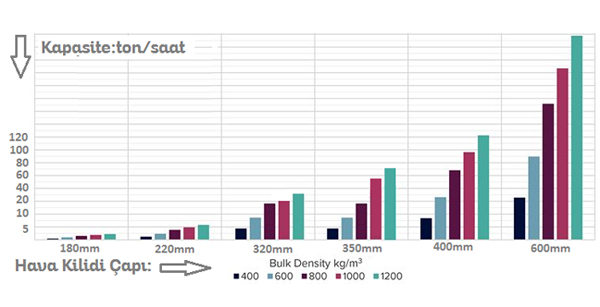

The reason why rotary valves and rotary feeders come in so many versions lies entirely in the type of material conveyed and the process. This is so important that a single mistake can even damage the material being conveyed. Simple off-the-shelf solutions may initially work when transferring simple materials such as flour. However, when the particle size of the material to be conveyed pneumatically and its behaviour under temperature and pressure vary, simple standard units will fail. Using engineering calculations based on the technical data you provide, covering operating pressure, back pressure, operating temperature, particle size, material type (abrasiveness, fragility, fibrousness etc.) and target capacity, we produce rotary valves that are basically the same but differ in duty cycle and service life, keeping your process running continuously with minimal downtime.
READ MORE Rotary Valve Catalogue