
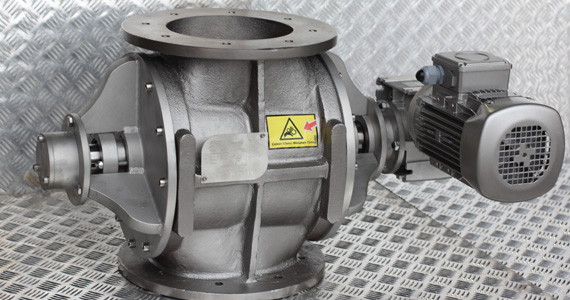
Rotary Valve Rotor Types and Selection
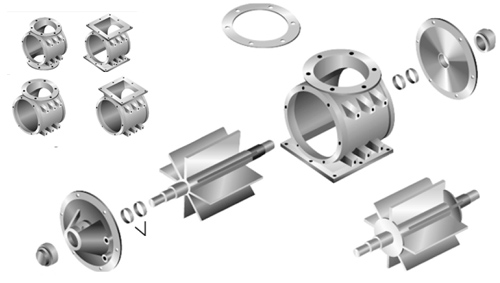
The rotor largely determines the performance of a rotary valve. By fitting different rotors in the same housing, a rotary valve can be adapted to powders, granules, sticky or fragile products.
Rotor by Product
With sticky and moist powders, radiused-pocket rotors prevent product from staying in the pockets. With granules and pellets, bladed (cutting-edge) rotors stop particles from being trapped and crushed between vane and housing. With fragile products, reduced-capacity rotors are used so that the pockets are only partly filled.
Adjustable and Soft Tips
On adjustable-vane rotors, the vane tips are adjusted outwards as they wear to restore the clearance. Polyamide or similar soft tips are used for sensitive products and in applications requiring low air leakage. Scraper rotors clean off product that sticks to the housing. For material options, see our heavy-duty rotary valve page.
What Is a Rotary Valve?
Known as a rotary valve, airlock or star feeder, this industrial equipment is used to separate bulk solids in powder and granular form from air. Below cyclones and in vacuum systems it performs separation, while in pneumatic lines it does the opposite, mixing product with air in the right proportion.
How Does a Rotary Valve Work?
A rotary valve lets bulk solids drop by gravity between its rotating rotor vanes while preventing air from passing in either direction between the vanes. This is how separation or mixing takes place; in short, the same equipment can both mix and separate.
What Types of Rotary Valve Are There?
Rotary valves can be used at various points in a process for powdered or granular raw materials, known as bulk solids. However, the flow behaviour and characteristics of these bulk solids lead to different rotary valve designs. The main factors are temperature, abrasiveness, chemical corrosion, and granule or particle size.
Why Choose a DOSERAY Rotary Valve?
Our 25 years of experience, the many problems we have solved and the know-how gained from hundreds of commissioned processes have given our products a consistent standard design and durability. As a result, even our standard rotary valve is considerably stronger than its equivalents in terms of sealing, durability and maintenance, and does not cause unplanned shutdowns. This is an important feature for processes running 24/7.
We work with you to choose the housing, rotor and sealing for your product.
-


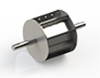
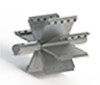
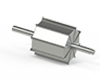
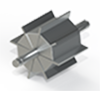
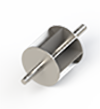
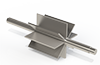
- A1-A2-A3: Open vanes
B1-B2-B3: Radiused/oval vanes
C1-C2-C3: Adjustable and replaceable vanes
D1: Rotary valve with closed or adjustable rotor (dosing) -
Drop-Out Box and Eductor Solutions for Rotary Valves
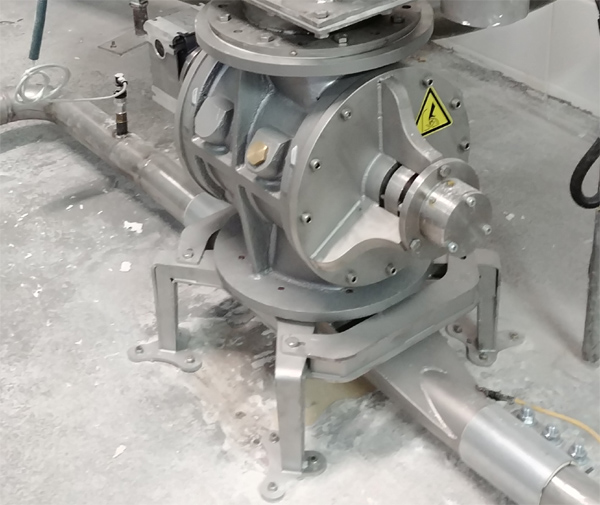
In some processes, although the rotary valve is part of a pneumatic conveying system, the orientation of the pipe inlet and outlet can cause problems during maintenance; removing pipework for maintenance is undesirable. In such plants, a standard rotary feeder can be used instead of a blow-through rotary valve (airlock), with a device that creates a venturi effect fitted underneath. This way, the connected lines do not have to be dismantled when servicing the rotary valve, which gives the process more flexibility. -

Rotary Valve Technical Dimensions
The flange and housing dimensions of the models are shown in the drawing below; the drawing can be revised for special connections.
Standard Rotary Valve Models
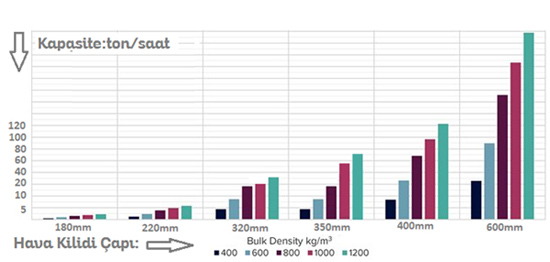
Our standard series is built in several housing diameters. When selecting a model, look not only at capacity but also at the product's particle size and the line pressure; a larger housing running at low speed usually lasts longer than a small housing running at high speed.
Wear-Resistant Rotary Valves
Wear-Resistant Rotary Valves and Airlocks
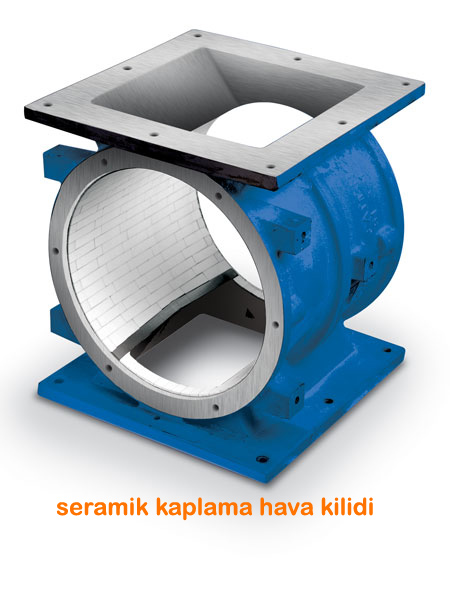
Hard, granular products such as sand, ash, calcite, cement and quartz gradually wear the rotor tips and the internal surface of the housing. As wear progresses, the gap between rotor and housing grows, air leakage increases and the efficiency of the pneumatic line falls.
On our wear-resistant models we focus on three areas: the internal housing surface (Ni-Hard casting, Hardox or hard facing), the rotor vane tips (replaceable or hardened tips) and the sealing (air-purged seals that stop dust from reaching the bearings). When these three measures are applied together, maintenance intervals are significantly extended.
 Rotary Valve Catalogue