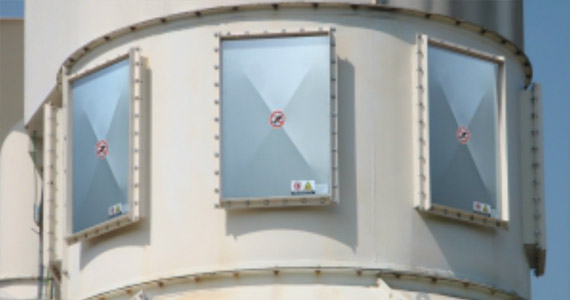
What is a dust explosion?
In short, a dust explosion is a reaction that occurs when a heat or ignition source, oxygen and combustible dust suspended in air come together in an enclosed volume and the conditions for an explosion are met. Powdered raw materials that look harmless at first glance but are combustible, particularly those used in the food industry, account for a considerable share of explosion risks. Chief among them are dusts of sugar, icing sugar, flour, starch, bran, pulses, various chemicals, PVC and petroleum-derived products.
Explosion vents allow the system to open to atmosphere in a controlled way for various physical and chemical reasons: pressure inside the enclosed volume exceeding controllable limits, an inadequate relief valve, a filter (if fitted) going out of service, or a low flash point of the process. In short, we can describe this as bringing the explosion under control.
Use of explosion vents
Enclosed volumes can take the form of equipment with mechanical movement, such as bucket elevators, screw conveyors, conveyors, hoppers, filters and cyclones. All an explosion needs is dust that can stay suspended in air, continuous mechanical movement, sufficient oxygen and an ignition source. It is therefore fair to say that there is a risk wherever there is movement and combustible dust.
An explosion vent, also known as an explosion vent panel, is like a seat belt or a fire extinguisher in a car. Its purpose is to protect the storage area at the moment of an explosion, direct the explosion in a safe direction according to the scenario, and prevent harm to the surroundings. The fact that this equipment, fitted to a silo or hopper, may never open even once in its service life never changes the need to use it. We must have a scenario for every volume holding explosive or combustible product.
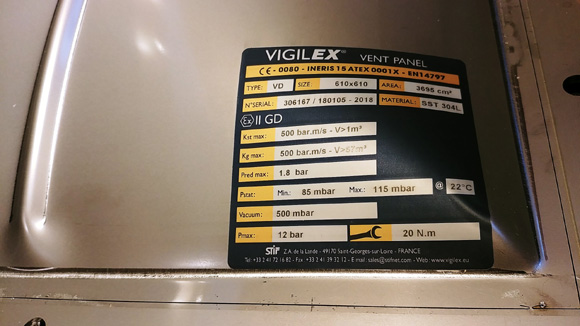
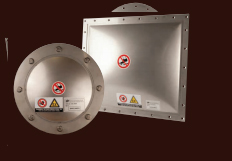
Explosion vents are designed to operate under vacuum or pressure, depending on the process. We serve industry in this field through our partnership with Vigilex. The products are made in square, rectangular and round shapes. Vacuum and pressure resistance directly determine the type of explosion vent.
Explosion vents that rupture to bring the space back to atmospheric pressure are used as standard in the range -200 / +500 bar, but special explosion vents up to +1 bar can also be manufactured depending on the process.
Processes that require explosion vents
Some very simple examples: explosion vents should be used in particular when storing and processing dusts that ignite at low temperatures, such as sugar, cocoa, combustible oily powders and coal dust. These products are given as examples because they are widely used; the list can certainly be extended to include various liquids, gases, processes and dryers. What matters is whether there is a risk of fire and explosion in the enclosed volume. Occupational safety, which is becoming ever more important in Türkiye and worldwide, also makes it necessary to use this product in applications such as pneumatic conveying, filters and cyclones. Just as Ex-proof motors have become part of everyday life, explosion vents will soon be widely used regardless of whether the area is classified as Ex.
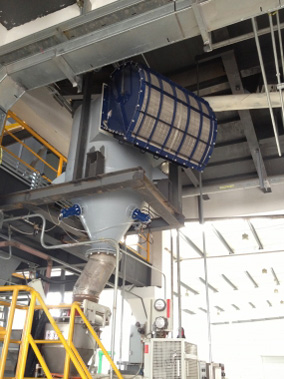
Flameless – flame arresting products
Any combustible dust suspended in air will burn when it meets sufficient oxygen and an ignition source. It is therefore very important to take this into account when designing processes. Neutralising a possible explosion without damaging the equipment or enclosed volume is not enough on its own; the controlled explosion must not harm surrounding equipment or people either. Although an explosion vent prevents major damage by releasing the explosion to the outside, flame arresters are needed to minimise any subsequent damage even further. This accessory also protects the explosion vent from external physical impacts.
Explosion vent solutions for pneumatic conveying processes
How should a process be designed when conveying a combustible dust?
1. Attention must be paid to earthing in the pneumatic conveying line to prevent static electricity, and pipe couplings that provide earth continuity must be used at the pipe joints.
2. The pneumatic conveying air must be cooled to at least ambient conditions, and conveying should be carried out with nitrogen from a nitrogen generator or another inert gas.
3. Filter elements must be selected in compliance with ATEX.
4. Where possible, the motors used in the system should be Ex-proof (ATEX).
5. An explosion vent must be used.
6. A gas analyser should be added to the process, and inert gas should be injected according to the measured concentration.
7. If the system includes a pulse-jet filter, nitrogen or CO₂ should be used as the cleaning gas. A relief valve (pressure relief valve) must be fitted to the silo, cyclone and filter that receive the product by pneumatic conveying. In pressurised systems, relief valves typically vent at around 280–380 mbar, while explosion vents in pressurised systems are commonly rated at 500 mbar. Attention must be paid to this to prevent the vents from rupturing for reasons other than an explosion.
Why explosion vents?
The damage explosions cause to people, the environment and workplaces can be far greater and more irreparable than that of other workplace accidents. Occupational safety must therefore never be overlooked, and it makes the use of explosion vents essential in hazardous or high-risk processes.
 Explosion Protection (VIGILEX) Catalogue