Cyclones and their dust collection capability
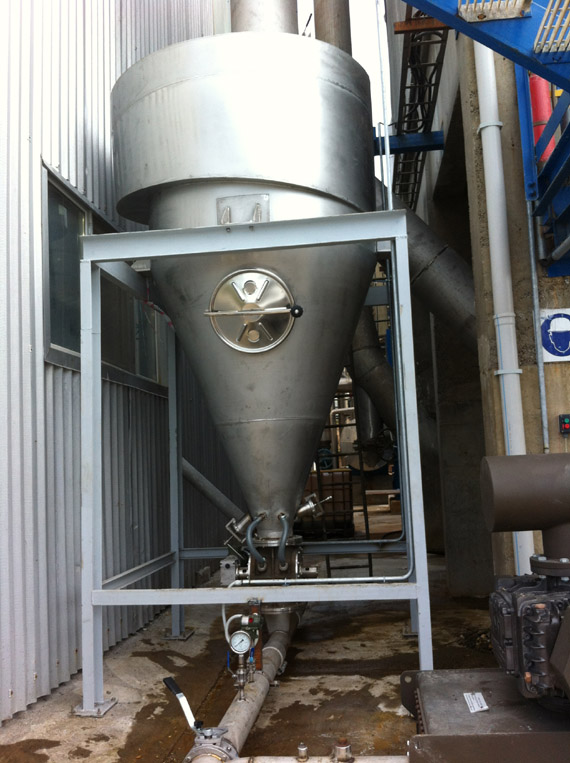
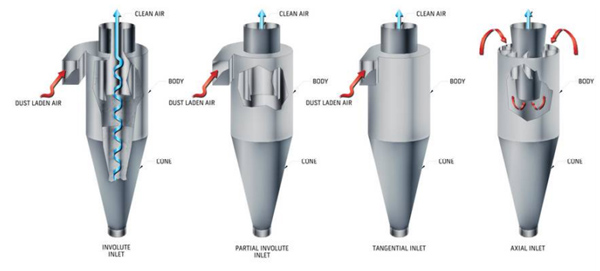
A cyclone is a separator with no moving parts. The air-product mixture entering through the tangential inlet starts to rotate in the body; centrifugal force throws the heavier particles against the wall, where they slide down, while the cleaned air rises through the central tube. This simple principle makes the cyclone a maintenance-free, economical pre-separator.
What is a cyclone?
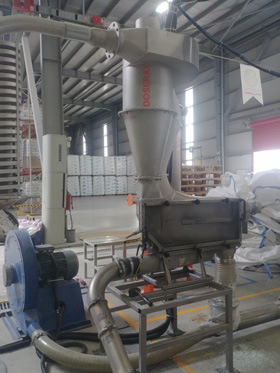
In pneumatic conveying, a cyclone is generally used at the end of the line, at the point where the product is discharged into a silo, mixer or weigh hopper. The cyclone separates most of the product; the remaining very fine dust is captured in the filter downstream. The filter therefore works under a lower load and the filter elements last longer.
The separation efficiency of a cyclone is determined by inlet velocity, body diameter and length-to-diameter ratio. Small-diameter, long-bodied cyclones are preferred for fine dusts, and multiple cyclones connected in parallel (multicyclones) for high flow rates.
Why choose cyclones?
Cyclones are far more resistant to high temperatures and abrasive products than filters. With no moving parts, maintenance is minimal, and continuous discharge is possible with an airlock underneath.
Cyclonic
filter systems
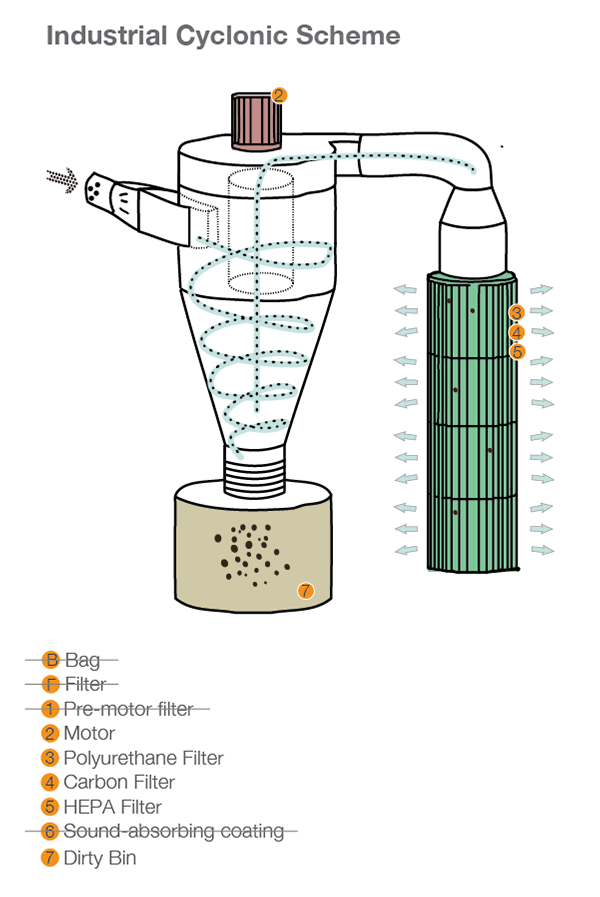

- Industrial cyclone design and cyclonic filters
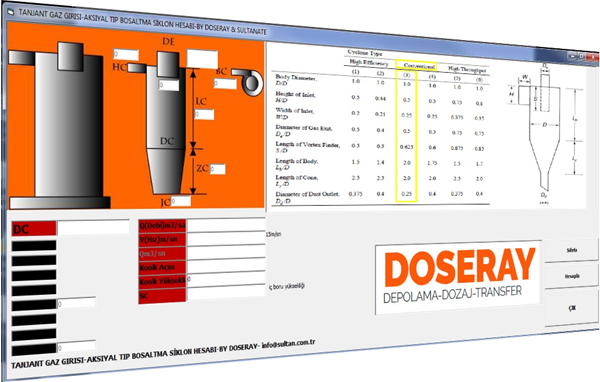
- Cyclones, widely used as dust collectors in industry, have three inlet/outlet sections: a tangential inlet, an axial outlet and a clean gas outlet. Although the type, design and features of a cyclone depend on certain basic concepts and criteria, they can vary with the process in which it is used. This is because the gas-dust mixture entering the cyclone does not consist of a single particle size.
- Pressure drop in cyclones is generally proportional to the square of the gas inlet velocity and lies between 6 and 200 mm water column. Pressure drop is the most important factor affecting cyclone performance. There are many experimental studies on this subject (the literature describes 7 basic models), and any cyclone designed will be close to one of them. The widely used high-efficiency cyclone types are those designed using the Leith and Licht approach, which has also been confirmed by experimental studies.
- Using a cyclone upstream of a pulse-jet filter, in particular, significantly extends the life of the filter media. It also greatly reduces sticking and smearing on the filter cartridges.
-

 Filter and Dust Collection Systems Catalogue