What are cyclones and cyclone filters?
Because raw materials processed pneumatically or mechanically are in powder and granule form, dust is inevitably released once they enter the process. To prevent this and separate the material from the air again, dust collectors, that is, cyclones, multicyclones and filters, are needed. In short, a cyclone is a steel construction that performs the first stage of dust separation by centrifugal action.
Depending on your process, the particle size of the conveyed material and whether it operates under vacuum or pressure, packaged dust collectors, pulse-jet filters and cyclone systems improve the working environment. To control dust emissions, filters and related equipment must always be used in processes where the raw material contains dust. Cyclones, which can capture dust down to 20 microns, can also work together with filters where they are installed.
The cyclone-filter combination, rarely used in Türkiye because most plants are small-scale, actually extends the life of filter bags in dust collection. Passing the dust released after pneumatic conveying first through a cyclone and then to the filter significantly reduces dust concentration. This is important for efficient filter use and long filter life.

How does a cyclone work?
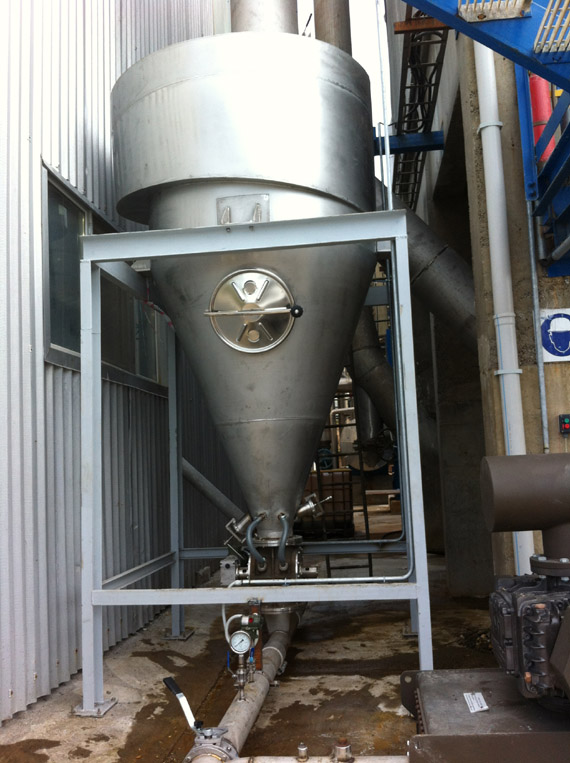
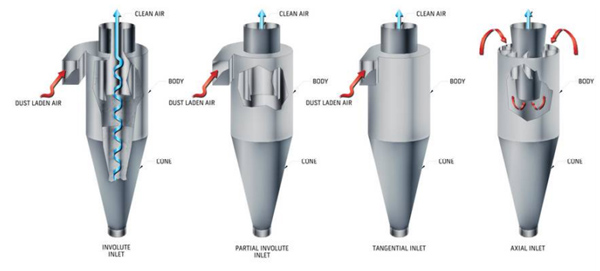
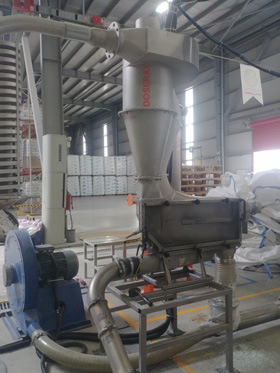
In pneumatic conveying systems, a cyclone is a conical construction that separates air from dust by centrifugal action. When the air-dust-granule mixture arriving at the cyclone at a given air flow enters the conical body, it slows down due to the larger cross-section and centrifugal force and forms a vortex. In other words, the air-dust mixture separates through this rotation, with the help of gravity and centrifugal force. The bulk solids move towards the bottom of the cyclone, while the air exits to atmosphere at the top. That, in short, is how cyclones work. Cyclone inlets can be square, rectangular, round or tangential, usually depending on the process. The design of a cyclone can also vary with the bulk solids passing through it. You can see a vibrating version for poorly flowing products below.
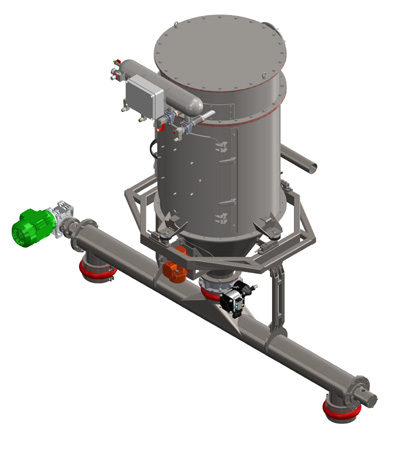
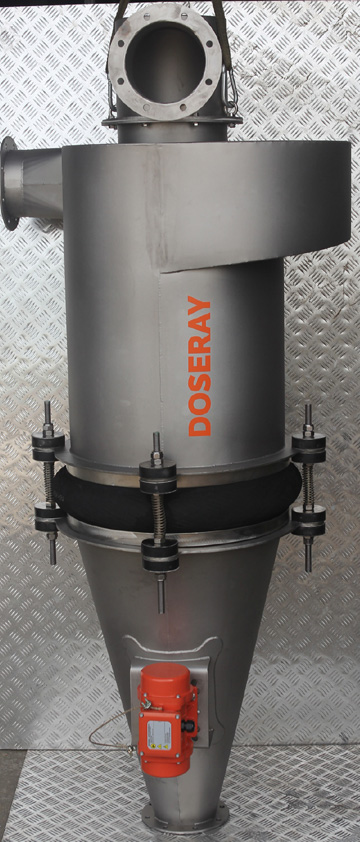
Depending on their design, cyclones can operate under positive or negative pressure, but the construction must be defined from the outset. Although both act as separators, suction cyclones need a sturdier construction because of the vacuum. A suction cyclone must also have equipment that can hold the vacuum, such as a flap valve or an airlock, underneath.
Why choose cyclones?
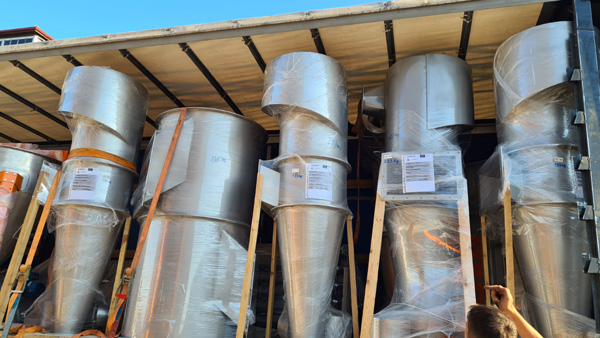
Cyclones have a wide range of applications in dryers, silos, separators, above mixers, upstream of filters, in feeders and many other places. There are different types: with filters, with separators and multicyclones. An airlock (cell wheel sluice) or flap valve under the cyclone ensures continuous flow at a set rate and better separation of the product from the air. A filter on top of the cyclone makes this separation more consistent and prevents dust from remaining suspended in the cyclone.
Cyclone
filter systems
- Industrial cyclone design
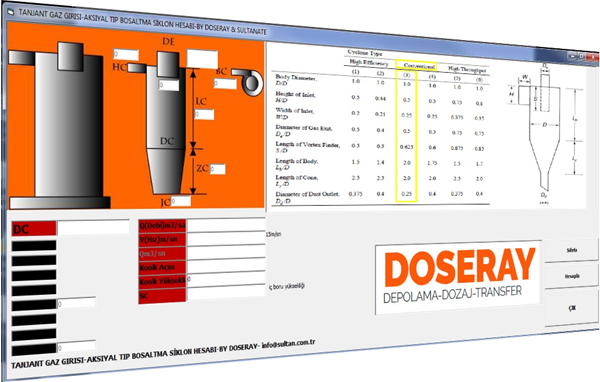
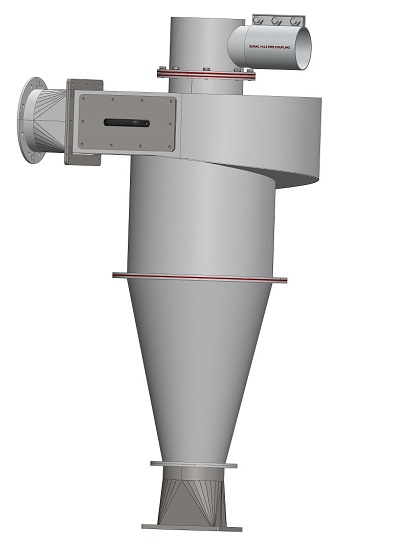
- Cyclones, widely used as dust collectors in industry, have three inlet/outlet sections: a tangential inlet, an axial outlet and a clean gas outlet. Although the type, design and features of a cyclone depend on certain basic concepts and criteria, they can vary with the process in which it is used. This is because the gas-dust mixture entering the cyclone does not consist of a single particle size.
- Pressure drop in cyclones is generally proportional to the square of the gas inlet velocity and lies between 6 and 200 mm water column. Pressure drop is the most important factor affecting cyclone performance. There are many experimental studies on this subject (the literature describes 7 basic models), and any cyclone designed will be close to one of them. The widely used high-efficiency cyclone types are those designed using the Leith and Licht approach, which has also been confirmed by experimental studies.
- Using a cyclone upstream of a pulse-jet filter, in particular, significantly extends the life of the filter media. It also greatly reduces sticking and smearing on the filter cartridges.
-

 ,
 Filter and Dust Collection Systems Catalogue