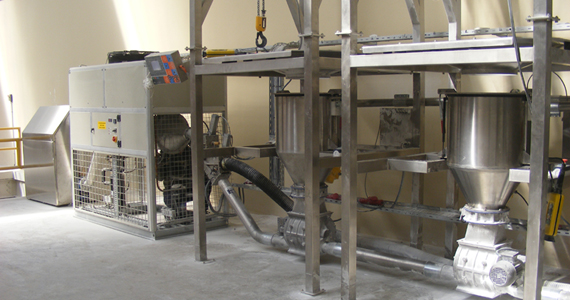
Dilute, Medium and Continuous Phase Pneumatic Transfer System
Dilute and Medium Phase
Pneumatic conveying, also called pneumatic transport, is generally preferred for granular and powder products and for products that are not very fragile. In this air-based transfer, the velocity ranges from 12 to 25 m/s depending on the phase density. Conveying is usually done with blowers or low-pressure compressors.
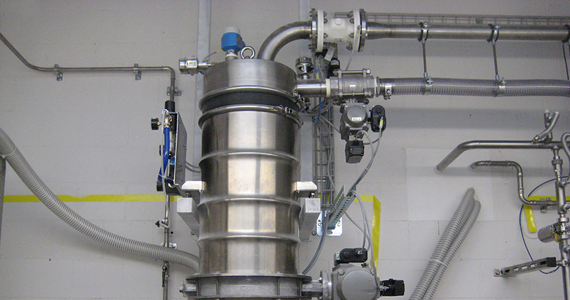
In dilute phase, pneumatic transfer is carried out in two ways, by vacuum or by pressure, briefly referred to as negative-pressure and positive-pressure pneumatic conveying. Medium and dilute phase pneumatic conveying is usually carried out in the -0.5 to +1.0 bar pressure range. The right method must be selected according to the process conditions. The centrifugal or Roots blowers used as air generators in pneumatic transfer draw in and compress ambient air with their impellers (lobes), creating vacuum at the air inlet and positive pressure at the outlet.
Compared with screw, belt and chain conveyors, pneumatic transfer and conveying systems are the most flexible conveying method. Although they have to work with a lot of auxiliary equipment and dust collection systems, this flexibility has made them one of the most preferred conveying systems.

- Vacuum Conveyors
-
-
Pneumatic conveying is the transport of powder and granular products from one point to another by an air stream inside a pipe. The product has no contact with the outside environment, the route can go wherever a pipeline can be laid, and a single line can feed several silos or machines.
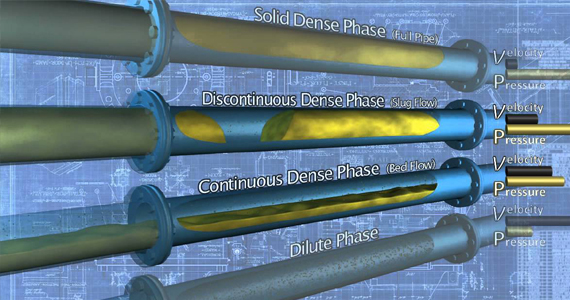
The conveying mode is named after the product concentration in the air: in dilute phase the product is carried in suspension in high-velocity air; in medium phase velocity and product load are balanced; in dense phase the product moves at low velocity in plugs. Fragile and abrasive products are better suited to dense phase, free-flowing and robust products to dilute phase.
How Do Pneumatic Conveying Systems Work?
The basic components are an air source (blower or compressor), a feeding device (rotary valve, pressure vessel or venturi), the pipeline and, at the end of the line, a receiver that separates the product from the air (cyclone or filter). In vacuum systems the air source is at the end of the line and the product is conveyed by suction.
Our Pneumatic Conveying Experience
The lines we have built for products with very different characteristics, such as flour, sugar, starch, milk powder, plastic granules, calcite, cement and carbon black, show that every product has its own conveying behaviour.
Why DOSERAY Pneumatic Conveying?
We calculate the line according to the properties of your product, and manufacture and commission all the equipment under a single responsibility.
What Is the Difference Between Pneumatic and Mechanical Conveying?
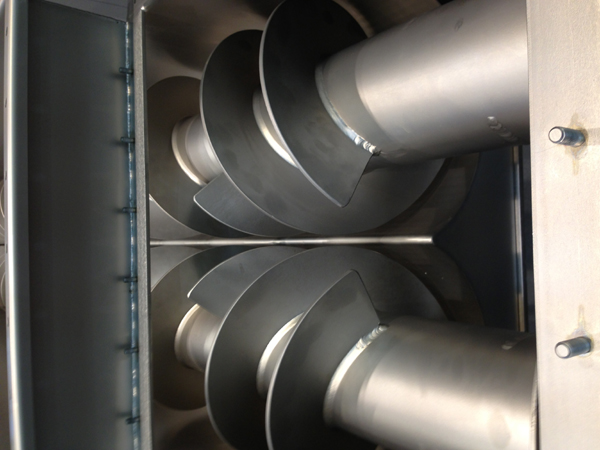
Pneumatic conveying offers route flexibility, easy cleaning and the advantages of an enclosed system. Over short distances and at very high capacities, however, mechanical conveyors such as screw conveyors or bucket elevators can be more energy-efficient.
READ MORE Pneumatic Conveying Catalogue