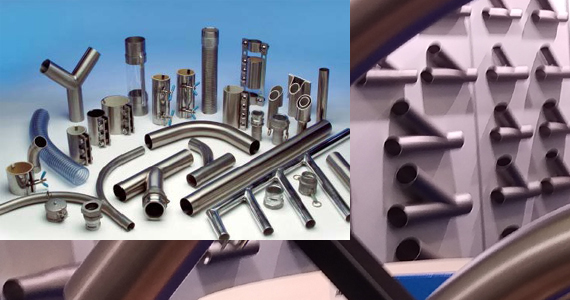

Pipe couplings and bends for pneumatic conveying
In pneumatic conveying processes, certain standard products must be used at the design and installation stage to ease material flow, simplify installation and prevent static electricity problems. The main ones are:
Long-radius bends
Pipe connection clamps (pipe couplings)
Flexible connectors and transparent hoses
PU wire-reinforced hoses
Basalt bends
All of this equipment is designed for DIN-standard pipes. You can find the dimensions of the bends and pipe connectors we import and install in the table below. Pipe couplings of EURAC (Europe), MORRIS (USA) and DVK (Germany) origin differ by vacuum and pressure class. They offer a wide selection to suit your process, with different sealing materials such as EPDM, NBR and rubber for food processes and a choice of lengths. Particularly in pneumatic conveying systems, which generate static electricity, pipe couplings not only join the pipes together but also provide earthing through their internal earthing strip. No separate earthing is therefore required where couplings are used.


.
Mid-range "HD" series couplings
DVK mid-range couplings are pipe couplings generally recommended for simple applications. Their aluminium construction makes them easy to fit, and they are popular because they can be removed with three bolts.
They are generally used on vacuum and low-pressure lines for conveying plastics and low-density materials. 
Heavy-duty "H" series couplings
EURAC H series couplings are pipe couplings generally recommended for heavy-duty applications and are used for conveying in high pressure classes. With three bolts, steel construction and an intermediate clamping plate, they are more robust than the other series. They can be used for conveying all kinds of powder and granular materials. They are one of the most effective products against the gradual loosening of bolts, particularly on lines subject to vibration and high pressure. They are very widely used on bulk tanker and dense phase lines.


Using standard couplings and bends
Flexibility is the most sought-after quality when designing pneumatic conveying systems. When the time comes, maintenance, revamps and wear problems can be resolved very quickly thanks to standard products. Ease of installation is another reason these products are preferred. Jobs such as joining and replacing DIN-ANSI pipes, dismantling them after a blockage, and maintenance call for standard products. In addition, couplings with an earthing strip eliminate the need for extra earthing work.
Long-radius
bends

In pneumatic conveying systems, the air–product mixture travels at 2–22 m/s depending on the conveying type. Long-radius bends are used so as not to increase line pressure or interrupt the flow during conveying. With long-radius bends in standard sizes, no additional modifications to the line are needed when they have to be replaced due to wear or for any other reason. We also offer wear-resistant engineering polymer bends.


 Pipe Connection Fittings (EURAC) Catalogue