

Micro Dosing Systems
In modern industry, quality and product standards depend not only on high production volume but on adding every ingredient in the recipe to the mix with perfect precision. Micro dosing systems are smart automation solutions that keep processes running accurately and consistently.
What Is Micro Dosing?
Micro dosing is the feeding of raw materials in powder, granule or liquid form (active ingredients, pigments, chemical additives, etc.) into the system in quantities of grams, milligrams or microlitres. Unlike standard systems that handle the main components by the tonne, micro dosing units keep under control the critical additives where even a small deviation can change the entire quality of the product.
Key Features of Micro Dosing Systems
· Precise Repeatability: Delivers milligram-level performance without deviation, even over thousands of production cycles.
· Smart Automation Integration: Works in full synchronisation with PLC and SCADA systems, automating recipe management and providing end-to-end traceability.
· Various Feeding Mechanisms: Micro screw feeders, vibrating trays, peristaltic or piston pumps are used depending on the material.
· Reliable Flow: Equipped with special agitators and vibrators that prevent moist or sticky powders from blocking the hopper (bridging/lumping).
· Dynamic Weighing Technology: Provides instantaneous, continuous mass control on the loss-in-weight or gain-in-weight principle.
Main Advantages of Micro Dosing Systems
· Minimum Waste and Cost Savings: Optimises raw material costs by preventing overuse of expensive ingredients.
· Consistent Quality: Eliminates manual weighing errors caused by human factors.
· Occupational Safety and Hygiene: Provides a safe working environment by transferring chemical or powdered materials in closed systems.

Weighing and Dosing Methods
1. Loss-in-weight principle (weighing by decreasing weight)
2. Gain-in-weight principle
A loss-in-weight unit works as follows: a hopper filled with material sits on load cells. Beneath the hopper is a single or twin screw feeder, attached to the hopper frame and included in the tare. Depending on the process, the feeder may also be a vibrating conveyor, an air slide or a rotary valve. The load cell signals and the screw feeder control are connected to the PLC.
The PLC software runs the screw feeder fast or slow according to the set quantity. The dosed quantity is calculated from the decrease in weight in the hopper.
In dosing systems working on the loss-in-weight principle, each feeder must have its own load cell system. Dosing can be performed with a screw, a gate valve or a rotary valve.
In systems where weighing takes place in a single hopper, weighing the hopper alone is sufficient. Taring in this process gives an accurate result more quickly.
Selecting the right dosing system is the responsibility of the process designer, and the properties of the raw material must always be taken into account in that choice.
The flight geometry of the conveying screws in micro dosing units can vary; as explained, this difference relates to the pitch at the same diameter.
Micro Dosing and Custom-Built Processes
In micro dosing processes, the pitch increases or decreases the speed and tolerance of the screw feeder. A single micro dosing unit can use more than one screw to handle different materials. Even with the same feed tube, the operating regime changes as the conveyed material changes, and tolerances may differ. For example, a powder may be dosed with a tolerance of 1 mm, while a granule can be dosed with a tolerance of 2 mm on the same unit by changing the screw.
Remember also that dosing can be performed not only with a screw but also with a rotary valve or a gate valve.
Although this information may seem encyclopaedic, it is intended as background to help you design your processes more accurately. Understanding how the system works makes it easier to reach the right result.
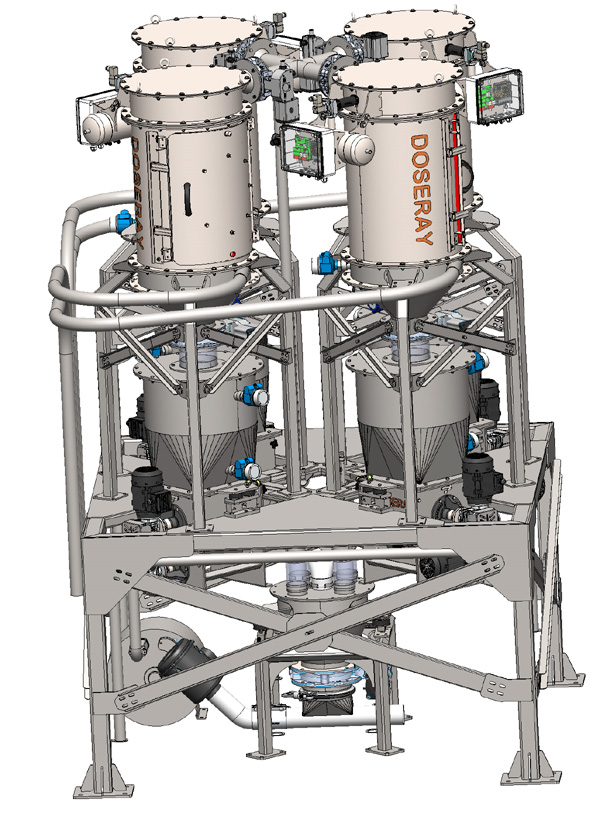

Micro Dosing and Precision Weighing

In the dosing processes we build, the goal is to operate with minimum fluctuation. In load cell-based dosing, depending on the process, 1 to 4 feeders can discharge into a single hopper on load cells. When several screws feed one hopper, the load on the hopper may vary depending on where the screws enter it. Fine details like these are at the heart of a micro dosing process.
READ MORE Micro Dosing Catalogue