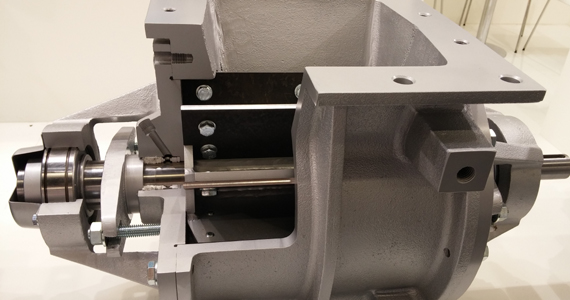

Air Leakage and Clearance in Rotary Valves
On a pressurised pneumatic line, the rotary valve's job is to stop air in the line from escaping into the hopper above. However, every rotary valve has some air leakage; what matters is keeping it at a level that does not disrupt the process.
Where Does Air Leakage Come From?
Air leakage arises in two ways: through the clearance between the rotor vanes and the housing, and from empty pockets filling with pressurised air from the line and carrying it back up. Air escaping upwards prevents product from falling into the pockets and reduces capacity; with powders it can also cause bridging in the hopper.
How Can It Be Reduced?
A precision-machined housing and rotor with tight clearances is the first way to reduce air leakage. Increasing the number of vanes keeps more vanes close to the housing at any one time. A vent opening in the housing on the return side releases the pressurised air from the pockets before they reach the product inlet. You can find all models on our main rotary valve page.
Rotary Valve Applications
Rotary valves are mechanical devices used mainly to drop the material to be conveyed into the line in pneumatic conveying, so that air and product mix in the right proportion.
Rotary valves have two functions, and any rotary valve can also be used with an eductor instead of as a blow-through airlock. In the first function it mixes the product with the air; in the second, it uses gravity to separate the product from the compressed air. Vane design, clearances and speed vary with the type of process and the product being conveyed. Depending on the properties of the material, a rotary valve can also act as a crusher, and can even be coupled with crushers. Rotary valves / rotary feeders are made from ST37 carbon steel, AISI 304 and AISI 316 stainless steel, Hardox and Ni-Hard. Airlock bearing types and sealing elements (packing glands, mechanical seals, felt seals) also vary with the process. Internal rotors of rotary valves / rotary feeders can be bladed, radiused, with adjustable vanes, with scrapers or in polyamide, among other options. 

Rotary Valve (Airlock, Rotary Feeder) Rotor Types
-

- A1-A2-A3: Open vanes
B1-B2-B3: Radiused/rounded pockets
C1-C2-C3: Adjustable and replaceable vanes
D1: Rotary valve with closed or adjustable rotor (dosing)
Rotary Valve – Airlock
Type that takes product in at the top and discharges it at the bottom (also known as an airlock or rotary feeder).
Blow-Through Rotary Valve
Conveying-type rotary valves that take product/raw material in at the top and drop it into the pneumatic line; also known as airlocks. Their design and sealing elements are built for pneumatic conveying.
Wear-Resistant
Products


Various features can extend the life of a rotary valve, but these are the ones that apply in general. Rotary valves and airlocks in all the diameters we produce can be built with the optional features you require.
In addition, if the system operates under pressure, that pressure puts the whole system under greater load and accelerates wear. The abrasive raw material mixed with air tries to escape, particularly through the sealing elements; over time this first damages the seals, causing dust in the surrounding area, and then damages the housing and end covers.
To avoid the process described above and to extend this natural process in a controlled way, the right selection must be made. In abrasive processes like these, the equipment inevitably has a limited life. What matters is to avoid unplanned shutdowns: even if the airlock is damaged, it should keep running and, in plants operating 24/7, hold out until the next planned shutdown.
 Rotary Valve Catalogue