

What Is a Hopper Bridge Breaker?
These are mechanical agitators used to prevent flow problems with poorly flowing solids such as calcite. Although they are flow-promoting, flow-aid systems, their use is generally limited to small diameters, mainly hoppers of 1-2 m³.
Also known as a silo discharger, this innovative bridge breaker is suitable for small silos and hoppers. It can easily be retrofitted to existing plant equipment and eliminates manual intervention, hammering and rodding. By ensuring a consistent, steady flow of all materials, it improves accuracy and clears blockages. Its main features include a rotating discharger with integrated fluidisation, additional aeration that breaks up and dislodges compacted or interlocked material, and a blade-mounted design that is easy to install, remove and clean daily (CIP). This improves safety and eliminates dust and the associated explosion risk. It is compatible with virtually all bulk solids.
Maximum scraper diameter: Ø600 mm
Outlet diameter: Ø200-320 mm

What Are the Advantages of a Bridge Breaker and Scraper?
Reduces noise and dust in the working environment.
Reduces segregation during material flow.
Minimal maintenance
Minimal operating costs
Hygienic design and construction
AISI 304 or 316 stainless steel options
CIP (cleaning in place)


Bridge Breaker Working Principle
Bridge breakers are essentially simple scrapers. By scraping the inside of the cone with very tight tolerances, they prevent the product from forming lumps and break up any compacted powder to restore flowability. They scrape and sweep through 360 degrees, run at low speed and are suitable for dry bulk solids.
Truly effective bridge breakers and silo dischargers are rare on today's market. Most devices solve one problem while creating another. Knocking or vibration, for example, can sometimes clear powder bridging, but it damages the silo and often causes the powder to segregate. Air injection, on the other hand, requires large amounts of dry compressed air, can create a dust explosion risk in the silo and may lead to additional sealing problems. All things considered, the bridge breaker is an effective method.
Bridge Breaker Cone Types
-
We know that every process is different. Even when the method is the same, very small details at critical points can bring a process to a standstill; we sum this up as "every process has its own regime". For this reason, every flow aid differs according to the type of product being stored or discharged. The main determining properties are:
1. Flowability of the material (how static it is)
2. Granule size or sizes
3. Granule structure (interlocking; for example, long, flat pasta-
shaped raw materials flow less easily than
shapeless granules)
4. Capacity
5. Abrasiveness
6. Corrosiveness
Depending on the case, all of these regime properties can change the angle, type and lining of the equipment's inner cone. Even a standard product can come in different variants.
No More Bridging Problems
Problems that arise when discharging a silo or hopper because of the product's properties indicate that equipment is missing from the process. Bridging is the most common of these problems. Equipment such as bin activators, rotoflow units, bridge breakers and silo vibrators are among the solutions.
Typical Applications of Bridge Breakers
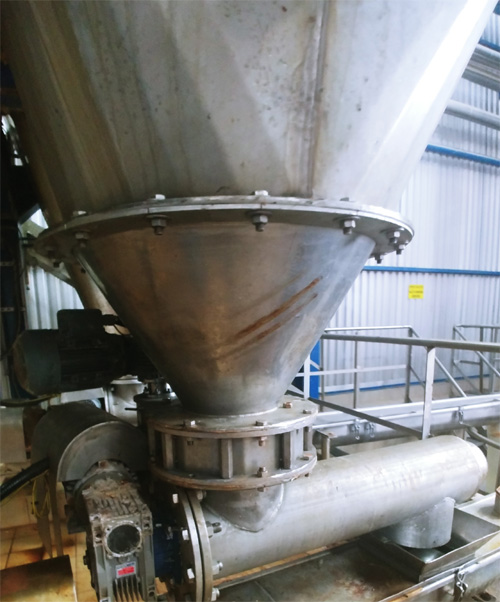
This bridge breaker and scraper is used effectively in the storage and discharge of the following bulk solids, and is especially preferred for dryer discharge hoppers: silica, calcium carbonate, titanium oxide, carbon, toner, ink, diatomaceous earth, glass fibre, textiles, paper dust, wood waste, shredded waste plastic, paints, pigments, spent tea leaves, incinerator ash, dried cake, activated carbon, oil cake, collected dust, pharmaceuticals, agrochemicals, citric acid, etc.
 Bin Activator Catalogue