Silo Discharge Systems – Bin Activators
Vibrating discharge cone, bin activator, silo vibrator and rotoflow are different names for the vibrating cone that discharges powders from silos and hoppers. The main problem with non-free-flowing materials received in bulk is their flowability after storage. This problem, which first appears as bridging, can cause serious discharge difficulties when combined with the physical and atmospheric conditions of the environment, moisture, density and the product's own characteristics.
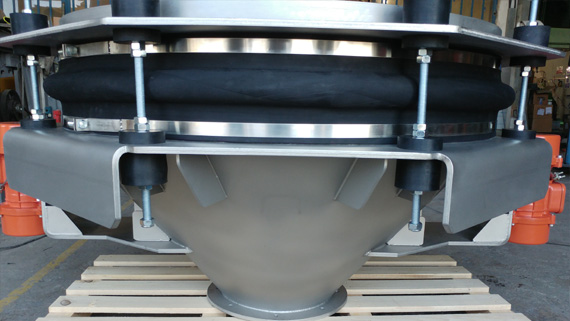
A bin activator is a discharge device mounted on the conical outlet of the silo with a flexible connection, carrying an internal cone (deflector) and vibrated by an externally mounted vibratory motor. Vibration is applied only to the lower section, not to the entire silo, so the product is directed to the outlet without fatiguing the silo body.
With products prone to bridging or rat-holing, such as flour, starch, cocoa, icing sugar and calcite, it is common to see that without a bin activator the silo empties only through its centre, while product stays at the sides for years. The activator empties the silo on a "first in, first out" basis, preventing the product from going stale and caking.

Additional Flow-Aid Systems
For very cohesive products, the bin activator can be combined with aeration pads, air cannons or mechanical agitators installed in the silo cone. Which auxiliary system is needed depends on the moisture and particle size of the product.
Bin Activator Cone Types
-
The angle and outlet diameter of the activator cone are calculated together with the silo cone. Steep cones ensure mass flow, while shallow cones are preferred where ceiling height is low; the outlet diameter is selected according to the rotary valve or screw conveyor to be connected beneath it.
Segregation
Solutions

In mixtures of different particle sizes, a silo that empties only through its centre causes coarse and fine particles to separate (segregation). The mass flow provided by a bin activator ensures the mixture leaves the silo in the same proportions in which it entered, maintaining recipe consistency.
READ MORE
 Bin Activator Catalogue