Dense Phase Pneumatic Conveying
Dense phase conveying is used particularly for abrasive and difficult-to-convey materials; the sand, cement and glass industries are typical examples.
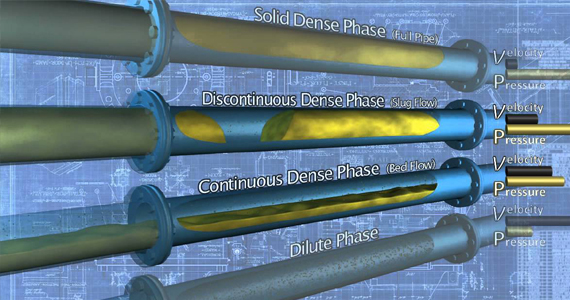
Because the material is abrasive, it is not allowed to strike the pipe wall at high speed; instead, the air-material mixture moves at a high pressure of 2–5 bar, filling the pipe, and is conveyed over long distances. Bulk cement tankers, for example, work on this principle. Instead of the high-flow fans used in dilute phase, this method uses high-flow, high-pressure screw compressors and dryers. A dense phase conveying system consists of a pressure vessel, the screw compressors that supply it, and boosters that provide air assistance at critical points. Dense phase systems are further classified mainly by their mode of continuous operation and by the discharge system of the pressure vessel. Whatever the type, the common feature is that the material is conveyed through the pipe at a higher density and lower velocity.

- Dense Phase Transporters
-
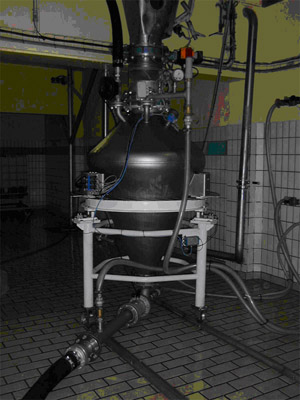
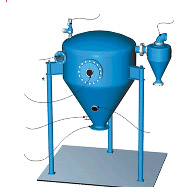
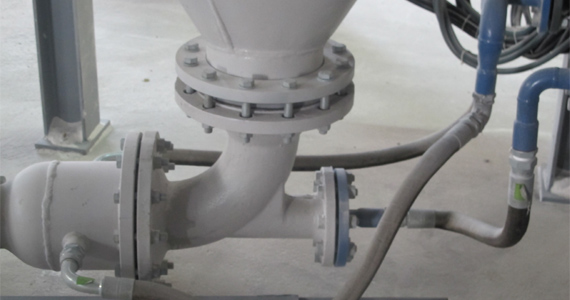
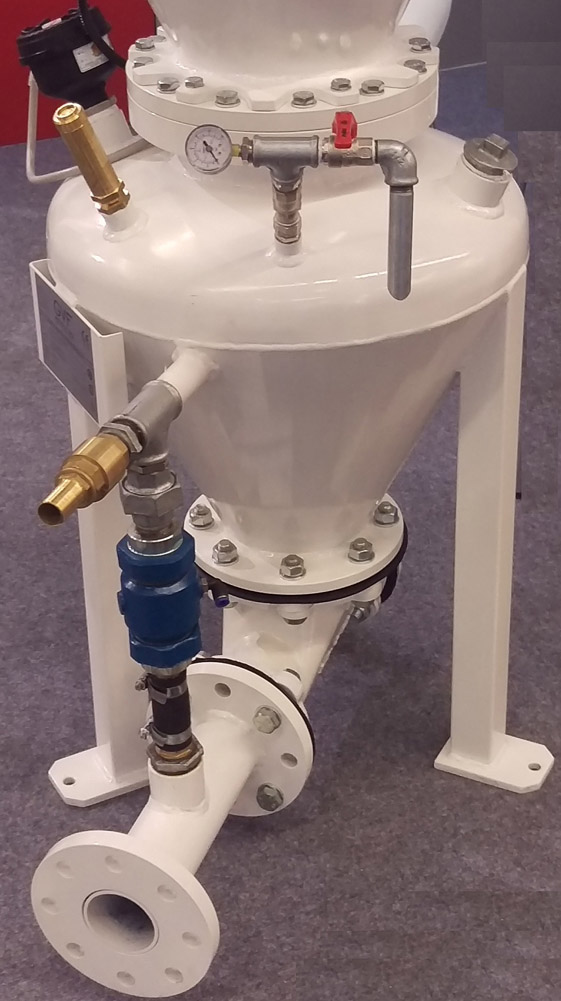
- High-pressure air is supplied to the vessel filled with the material to be conveyed; a valve then opens and the air-material mixture is transferred to a cyclone, a silo or the target mixer. This method is particularly preferred for materials that might fibrillate or whose characteristics could be impaired by friction during conveying. By its nature, dense phase conveying works with different equipment from dilute phase; the conveying equipment is more robust than in dilute phase. This high-pressure conveying uses thick-walled pipes and special basalt bends. Various technologies have also been developed to prevent material wear in the bends.
In dilute phase pneumatic conveying, the centrifugal or Roots blowers used as the air source draw in ambient air and compress it to create a conveying pressure. Water droplets from the relative humidity of the atmospheric air act as a good conductor during compression and cause the conveying air to heat up. Depending on the operating pressure of the process and the conveying velocity, this temperature can at times reach up to 80 °C.
If the material to be conveyed is sensitive to these temperatures, pre-cooling and after-cooling of the compressed air may be required before it enters the process. Instead of the complex dilute phase set-up needed to manage air temperature and velocity and reach the required capacities, a dense phase transporter (pressure vessel conveyor) may be the most suitable solution.
How Does a Pneumatic Conveying System Work?
Every product conveyed by air is first mixed with air and then separated from it. Although both steps are challenging, pneumatic conveying is always preferred for its flexibility.
Mixing is done with rotary valves, loading stations and venturis, and separation with filters. In short, pneumatic conveying means dust: separating it and filtering it reliably. Blowers, that is, low-pressure, high-flow fans, are used as the air source.
Although the process may look like nothing more than mixing product with compressed air and conveying it, it requires serious engineering work and experience. Pressure and vacuum can also be combined in pneumatic conveying processes.
Experience...
In pneumatic conveying, every product has its own characteristics, so each product also has a different density and efficient conveying pressure. This determines the conveying mode. The two main modes are vacuum conveying and pressure conveying. If you try to convey sugar on a line designed for flour without making any changes, your process will inevitably fail; none of the equipment you use will work properly. If, however, the process is designed correctly and built with the right devices and equipment, you can convey both sugar and flour on the same line simply by changing parameters in the automation. This example shows how important a solid foundation and experience are in practice.
Pneumatic vs
Mechanical Conveying
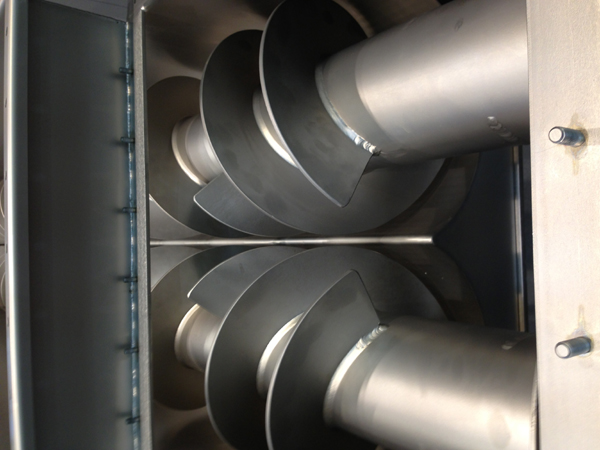
Although mechanical conveying may seem a demanding method with fixed patterns, it is the most economical solution in terms of electricity consumption. Over long distances the investment cost is high, but energy use is low. In pneumatic conveying systems it is also generally used for volumetric feeding at a constant rate.
Pneumatic conveying (vacuum conveying) is the most flexible conveying method compared with screw conveyors, belt conveyors and chain conveyors. Although it needs to work together with many auxiliary instruments and dust collection systems, this flexibility makes it the most widely preferred conveying system.
 Pneumatic Conveying Catalogue