

What Is a Petcoke Rotary Valve and Where Is It Used?
The airlock, also known as a rotary valve, is one of the key items of equipment in pneumatic conveying systems. Depending on the type of process and the application, it is also called a star feeder, cellular wheel feeder, rotary feeder or rotary lock. It controls the dosing or flow of product from equipment such as silos, hoppers, cyclones and mixers, and prevents air flow between the zones where material under pressure, vacuum or gravity is received and discharged.
Which Rotary Valve Should Be Used for Petcoke Firing Processes?
Lime is produced by burning limestone; this burning is usually done in kilns and directly affects product quality. The equipment used to weigh petcoke, an abrasive raw material, and feed it into units such as combustion chambers and kilns must be of a special design. With our process knowledge and experience, we manufacture dedicated rotary valves for cement and lime plants and can customise our products to the operating pressure. Designed specifically for the system and highly wear-resistant, this equipment keeps your process running smoothly.
Rotary Valve Applications
Silo discharge, cyclone discharge, dust collection, dosing, pneumatic conveying, belt conveyor feeding/discharge, screw conveyor feeding/discharge, machine and system feeding/discharge, raw material filling
Rotary Valve (Airlock) Models
Various models are available for different applications and raw materials. Different optional features are offered to suit the rotary valve (airlock) to the place of use (silo, cyclone, pulse-jet filter, conveyor, pneumatic conveying systems, etc.), the material to be handled (dusty, granular, flexible, abrasive, hard, etc.) and the ambient conditions (temperature, humidity, corrosion, etc.).
Airlock – Rotary Valve
The type that takes product in at the top and discharges it at the bottom (also referred to as an airlock or rotary valve).
Blow-Through Rotary Valve
Conveying-type units that take the product, i.e. the bulk solid, in at the top and drop it into the pneumatic line; also referred to as blow-through or feed rotary valves. Their design and sealing elements are made for pneumatic conveying.
Wear-Resistant Rotary Valves
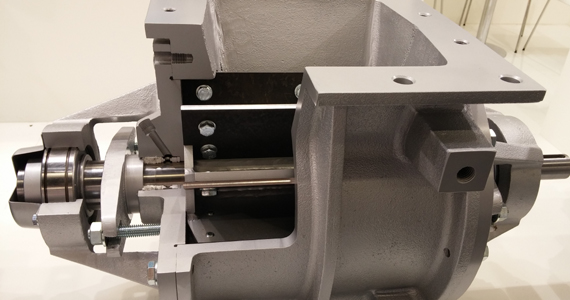
Rotary valves (airlocks) are mainly used to discharge dust beneath pulse-jet filters, in separators, to drop material from a hopper into a pneumatic line, to send bulk solids from a silo through a pneumatic line, to separate air from dusty material, to feed granular and powder raw materials proportionally into a pneumatic line during big bag discharging, and for gravimetric dosing.
Pneumatic conveying processes differ not only by phase but can also be subdivided within the same phase. Low-pressure, i.e. dilute phase, conveying can be divided into two groups: vacuum and pressure. This classification also leads to differences, albeit small, in rotary valves. We therefore manufacture the rotary valves for vacuum and pressure lines to suit your process.
READ MORE Rotary Valve Catalogue