
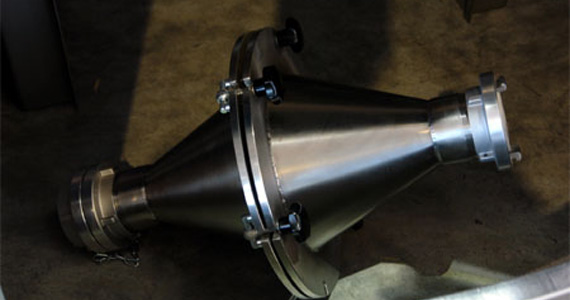
Process Protection Sieves
Even if the bulk solids delivered to your process have already been sieved, it is important for safety that they pass a final check. This method is frequently used, especially in food processes (biscuit and bread manufacturers, confectioners using large quantities of bulk solids, etc.).
For this reason, particularly in food processes, all bulk solids undergo final sieving and separation before entering the mix and the process. The same equipment is also used within the process as a pre-separator ahead of fine sieves to prevent them from clogging easily. This method is chosen to remove coarse particles and extend the cleaning and inspection intervals of the sieve.
This can be done magnetically and mechanically, either together or separately.
Silo protection – safety sieve
Bulk solid raw materials entering the process pass through a coarse pre-separation that does not reduce capacity. This is more a separation than a sieving operation. The main purpose of these fixed, high-throughput sieves is to prevent very large pieces from entering the silo or process. This protects the downstream sieving machines, or separates pieces that might escape the sieving machine before they cause problems.
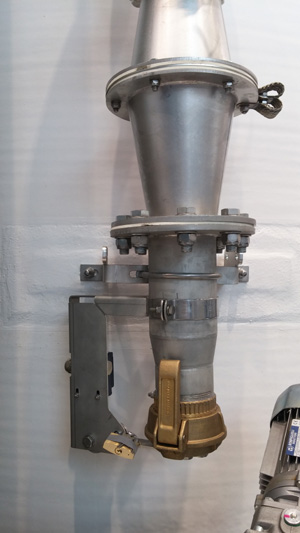
How do centrifugal sifters and pre-separators work?
The material is fed pneumatically into the product inlet and directed by a feed screw into the cylindrical sieving chamber. Helical paddles rotating within the enclosed volume continuously drive the material towards the screen; the centrifugal force acting on the particles rapidly throws the material to be sieved out through the apertures. These rotating paddles, which never touch the screen, also break up soft lumps. Oversize particles and foreign matter are ejected through the discharge valve.
However, if coarse pieces capable of damaging the sieve's internals reach it during these operations, the high speed can damage the machine, the screen mesh and the housing. Magnetic and coarse-particle traps should therefore be installed ahead of the sieving machine inlet.
Process safety with magnetic separators
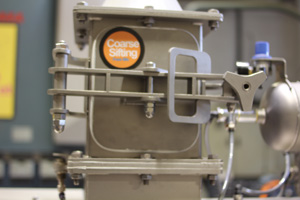
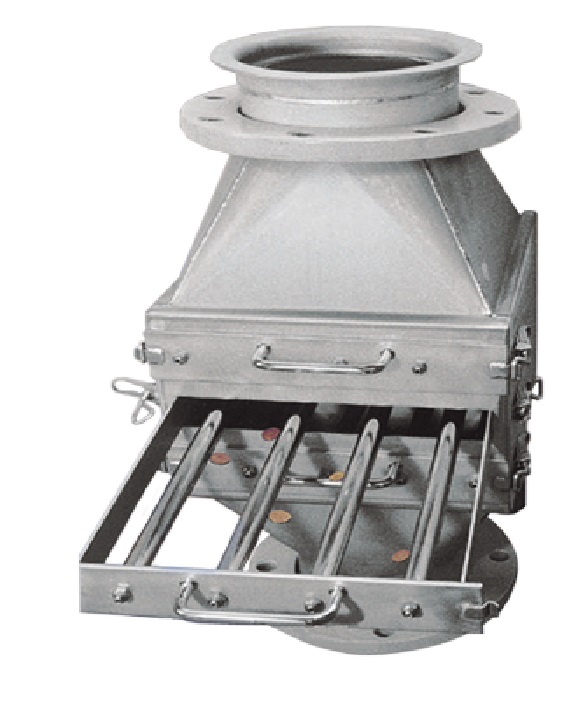
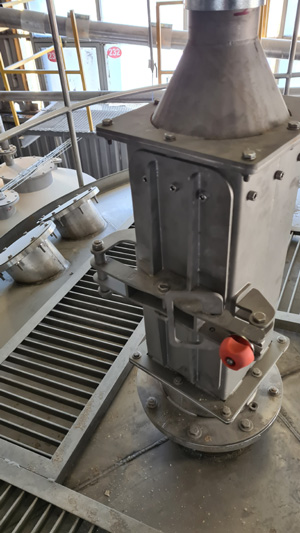
Magnetic metal separators (magnetic bars) can work together with protection sieves. Fixed-bar models are installed inside the sieve housing shown in the image above, so that metal separation also takes place during conveying. Thanks to the easy-opening cover, the process can be visually inspected at reasonable intervals, ensuring food and occupational safety.
Custom-designed process sieves
We remove foreign matter from your powder or granular bulk solid raw materials with centrifugal and protection sieves before they enter your process.
Your Process Under Control
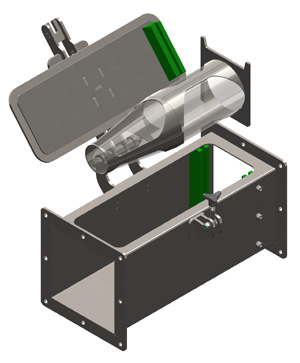
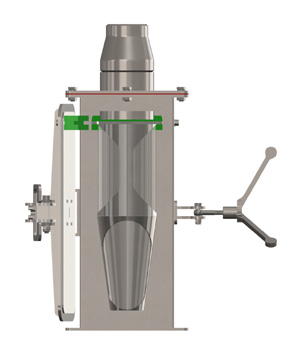
Custom sieve manufacturing (vacuum – pressure)
K
P
During pneumatic conveying (vacuum or pressure), the product is sieved at the final stage before it enters production. This sieving allows only granular or powdered bulk solids of acceptable size into your process, while other particles that do not meet the required specification are separated out. This is especially important for food processes.Flour arriving from the mill, for example, may contain flour moth larvae. If these larvae are not separated out before production, they can lead to very unpleasant results in manufacturing. One of the key features of these in-line sieves is automatic cleaning: in batch systems, the sieve cleans itself automatically during line purging.
 Screening (Sieve) Catalogue