

Rotary Valve Definition
A rotary valve is a mechanical device that transfers material by means of a rotor with pockets of defined volume turning inside a housing. It regulates the material flow and, at the same time, seals between zones at different pressures, contributing to the efficient operation of pneumatic systems. 
Design and Technical Features of the Rotary Valve
Rotary Valve Housing
Rotary valve housings are usually made of cast iron, aluminium or stainless steel. In the food and pharmaceutical industries stainless steel is preferred for hygiene reasons. The housing is designed to withstand wear and pressure.
Rotary Valve Rotor
The rotor consists of pockets of equal volume and is the most important component determining the capacity of the system. The number and volume of the pockets are selected according to the density and flow properties of the material to be conveyed.
Rotary Valve Bearing System
The rotor is driven by an electric motor and gearbox. The bearing system keeps the rotor running stably under axial and radial loads. A suitable bearing design is critical for low vibration and long service life.
Rotary Valve Sealing Elements
Especially in pneumatic conveying applications, the rotor-to-housing clearances are set precisely to prevent air leakage. Some designs use elastomer or metal seals.
Rotary Valve
Type that takes product in at the top and discharges it at the bottom (also known as an airlock or rotary feeder).
Blow-Through Rotary Valve
These are conveying-type rotary valves that take the product from above and feed it into the pneumatic line; they are also called blow-through valves. Their design and sealing elements are built for pneumatic conveying.
Wear-Resistant
Rotary Valve
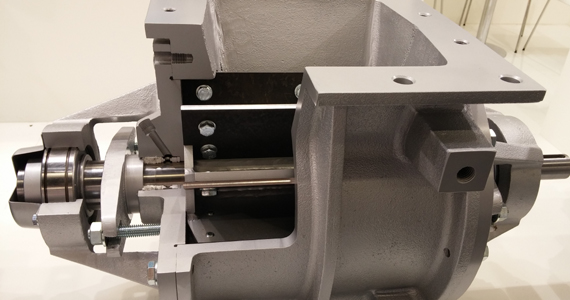
Rotary Valve Operating Principle
A rotary valve works by filling the pockets on the rotor through the upper inlet and carrying them, as the rotor turns, to the lower outlet. When the pockets reach the bottom, the material inside is discharged by gravity or by pneumatic pressure. This mechanism provides a continuous and controlled material flow.
Rotary Valve Applications
Rotary valves are widely used in many industries:
• Dosing of flour, sugar, starch and grain products in the food industry
• Transfer of powder and granular chemicals in the chemical and petrochemical sector
• Feeding of raw materials that require precise dosing in the pharmaceutical industry
• Conveying of fine-grained bulk solids in the cement and mining industries
• Granular raw material feeding systems in the plastics sector
Advantages of the Rotary Valve
• Provides a continuous and controlled material flow
• High dosing accuracy
• Acts as an airlock in pneumatic systems
• Integrates easily into automation systems
• Relatively low operating and maintenance costs
Rotary Valve Problems
• High risk of wear with abrasive and sticky materials
• Incorrect rotor-to-housing clearances can cause sealing problems
• Performance can drop if regular maintenance is not carried out
Rotary valves are among the essential pieces of equipment for material handling and dosing in industrial processes. With the right design, suitable material selection and regular maintenance, they deliver high efficiency and a long service life. As industrial automation and process control technologies advance, the applications and technical capabilities of rotary valves are expected to expand further.
 Rotary Valve Catalogue