
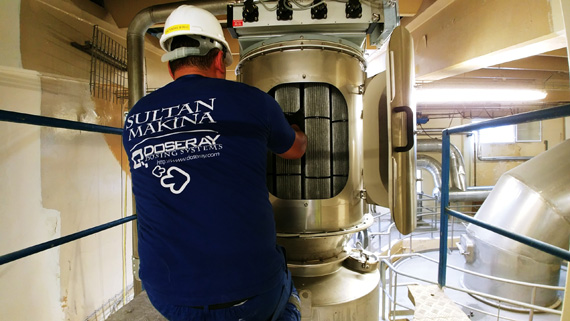
Foundry Filter Applications
A filter is the equipment that separates air from product in enclosed volumes such as the silos and hoppers in which bulk solids are stored in industrial plants. All the bulk solids used in the casting process (new sand, coal dust, bentonite, etc.) can escape into the surroundings as they enter the process, so proper filtration is essential. Filters are frequently used on bentonite, new sand and coal dust hoppers and silos, and are widely used from start to finish of the process in foundries and steel plants. Filters are required in particular on all silos filled by bulk tanker, pneumatic conveying, bucket elevator and other mechanical systems. All the filters we manufacture retain particles down to 1 micron. In foundries, filters are widely used to stop bentonite, sand and coal dust carried by pneumatic transporters from spreading into the surroundings, and on the storage silos for these materials delivered in bulk by tanker. Filters for additives and additive vacuum loaders used in core shops, along with other applications, are listed below.
Sand preparation: Dust from hoppers and silos, as well as from other equipment such as belt conveyors and core breakers, is collected.
Sand cooling: The area where sand is cooled. It is a major source of dust and must be filtered.
Core shop: Here, dust released while feeding the core machine hopper is filtered.
Induction furnace: During casting, the vapour and fumes from the pouring mouth of the induction furnace must be extracted and filtered in a dust collection unit.
Grinding: Dust produced when machining castings is collected in a central filter.
Shot blasting: Dust produced while giving castings a uniform surface finish is collected in a central filter.
DOSERAY filter solutions designed to reduce exposure to dust, silica and heavy metals in foundries create a working environment that is safer for people and the environment. It should be remembered that dust control is a never-ending process. Dust released by foundry processes must be monitored continuously; going a step further and recording measurements regularly will be very helpful in solving problems.
The most critical point in foundry processes is preventing dust from dispersing at source. Dust must never escape the enclosed volume, and any dust that does escape must be directed to the filters. Because foundries are very large spaces, released dust easily remains suspended in the air and is difficult to remove, which calls for very large equipment, fans, ductwork and energy. Air currents inside the plant also make matters worse. The first step towards a solution, therefore, is to control dust at source and contain it within the enclosed volume against mechanical displacement. This means using an extensive network of filters.
Filter Features
Bulk solids received in bulk or in bags and stored in silos before entering the process (cement, PVC, calcite, bentonite, ash, carbon powder, gypsum powder, lime powder, carbon black, silica sand, petcoke, dense soda ash, light soda ash, flour, sugar, cocoa…) are generally conveyed pneumatically. Silos therefore always need a filter to separate the air from the product.
Filtration areas of 14, 24 and 48 m² are commonly used in processes and silos. The cleaning area is proportional to the housing area, and selection is based on the volume of air entering the silo.
Bulk tankers discharge in dense phase with an air flow of 700-1,000 m³/h. Although the smallest size (14 m²) can handle this flow, at the end of unloading tanker drivers send a large blast of air into the silo to purge the air remaining in the equipment. This can cause problems ranging from the safety valve (relief valve) opening to damage to the filter.
Silo filters must therefore be designed to cope with these situations; we recommend using silo filters with a diameter of 800-1,000 mm and a filter area of 24-48 m².
All the filters we manufacture have high air permeability and are easy and safe to install and easy to use.
The filter element (filter media), diaphragm valves, control box and housing are more robust than comparable products. Housing sheet thicknesses range from 1.5 to 2 mm, giving high mechanical strength.
The filter media are suitable for food processes and are also antistatic and water-repellent. Although we support domestic manufacturing, we source the critical components inside the filter in partnership with world leaders in their fields: filter media from jp-airtech (Denmark) and diaphragm valves from SMC (Japan).
Another feature is that all filter housings, although they are silo filters, can withstand vacuum down to -400 mbar. A fan can be fitted to any filter as standard. Because the filter has a single outlet, it can also be connected to a central dust collection unit if required.
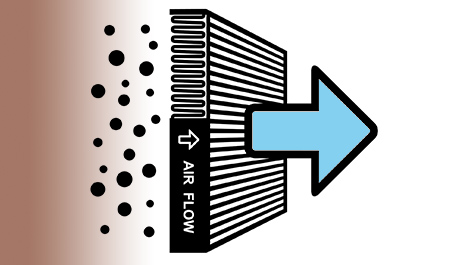
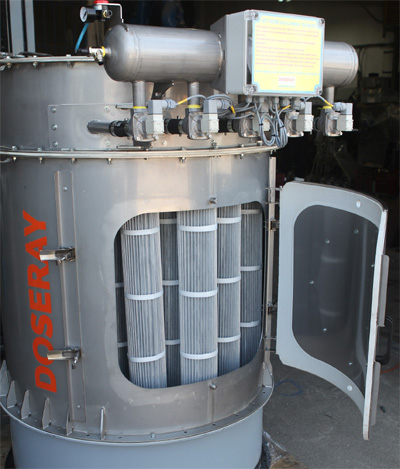
Pulse-jet filter working principle
All filters have an automatic cleaning system. These fall into three main types: mechanical vibrator, reverse air (with cleaning fan) and pulse-jet air blast. Each of these three main groups covers different applications and technologies.
Mechanical, i.e. vibrator-cleaned, filters are an older technology that is no longer widely used. Reverse-air filters with cleaning fans are used in compartmentalised filters with very large filtration areas and high air flows.
All the filters we manufacture are cleaned in reverse using 5 bar process air, air jets, venturis and air pulses. This technology is called pulse-jet. Compressed air stored in the air tank (header) on the filter is released via a diaphragm valve for 0.1 s at high flow, high velocity and high pressure, pulsing the filter cartridge (bag) in the reverse direction so that the dust on it falls off and the filter is cleaned.
Domestic Filter Solutions
Our country has ample know-how and experience in this field. Overlooking this capability and looking for solutions abroad indirectly harms the national economy. Filtration and dust separation is now a field in which solution partners can easily be found within our own borders.
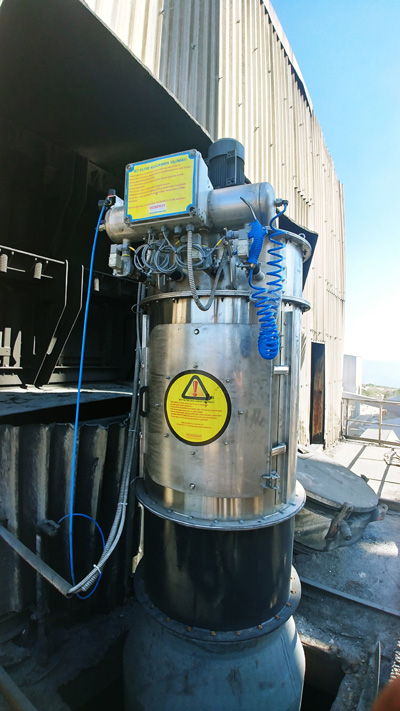
- In addition to silo, bulk tanker, foundry and core shop filters, our production programme also includes new sand, bentonite and coal dust filters.
 Filter and Dust Collection Systems Catalogue